
Article Summary:
Royal Coffee has opened a new quality control lab in Addis Ababa, Ethiopia, marking a major milestone in strengthening its presence at origin. Led by longtime Royal representative Haileyesus Andualem, alongside QC Manager Segenet Gashaw and QC Assistant Betelhem Assefa, the lab is a state-of-the-art space designed for cupping, calibration, and collaboration. Situated near Bole International Airport in the Ethiopia-China corridor, the lab serves as both a functional hub for evaluating Ethiopia’s finest coffees and a welcoming meeting space for visitors and partners. The facility reflects the heart and heritage of Ethiopian coffee built on precision, hospitality, and connection. As Haile and his team oversee quality and flavor calibration for Royal’s imports, the Addis lab stands as a gateway between Ethiopia’s producers and the global specialty coffee market.
Dispatches from Royal Coffee’s new QC department in the heart of Ethiopia’s capital city.
Haile beams with pride, his features irradiated with a glow descending from a crown-shaped chandelier above a set of charcoal couches and round marble coffee tables. Through wooden slatted dividers and clouded glass, I can see the sample preparation room and the QC lab, enormous onyx-marble tables on casters, a grinder gently whirring and then bursting to action as samples are poured whole-bean into its maw, expunged as dust, the aroma filling the room of fresh coffee.
Not just fresh coffee. The finest and freshest of coffees, from its motherland – Ethiopia.
In some ways, the lab is like many others – there’s an office and a reception kiosk, a long table for desk work, a small kitchen, coffee paraphernalia everywhere, endless drawers for samples which will be logged and roasted and cupped and stored and used as references and used for purchases and used for sales and eventually exhausted, forgotten, or discarded. Cupping glasses and spoons and scales populate the lab, holding coffee, promising potential.
In some ways, the lab is like no other. It is gorgeous, designed for efficiency and grace, spacious, luxurious. And, maybe most importantly, it’s Royal’s.
Haileyesus Andualem, our man in Addis, has been in the employ of Royal Coffee for years now, and there’s a fair chance that if you’ve visited Ethiopia you’ve met him. A kinder, more generous man I’m sure does not exist. A more critical keystone to the edifice of trade between the world’s first and arguably best supplier of Arabica coffee, and us, one of the leading importers of the crop, could not be more suitably placed.
A long time coming but well worth the wait, Royal Coffee’s lab in Addis Ababa is the brainchild of Haile, and Max Nicholas-Fulmer (CEO), Peter Radosevich (International Sales), and Richard Sandlin (Special Projects). It’s an elite and eminently functional facility that wouldn’t possibly work without our guy Haile, the adhesive that binds it all together.
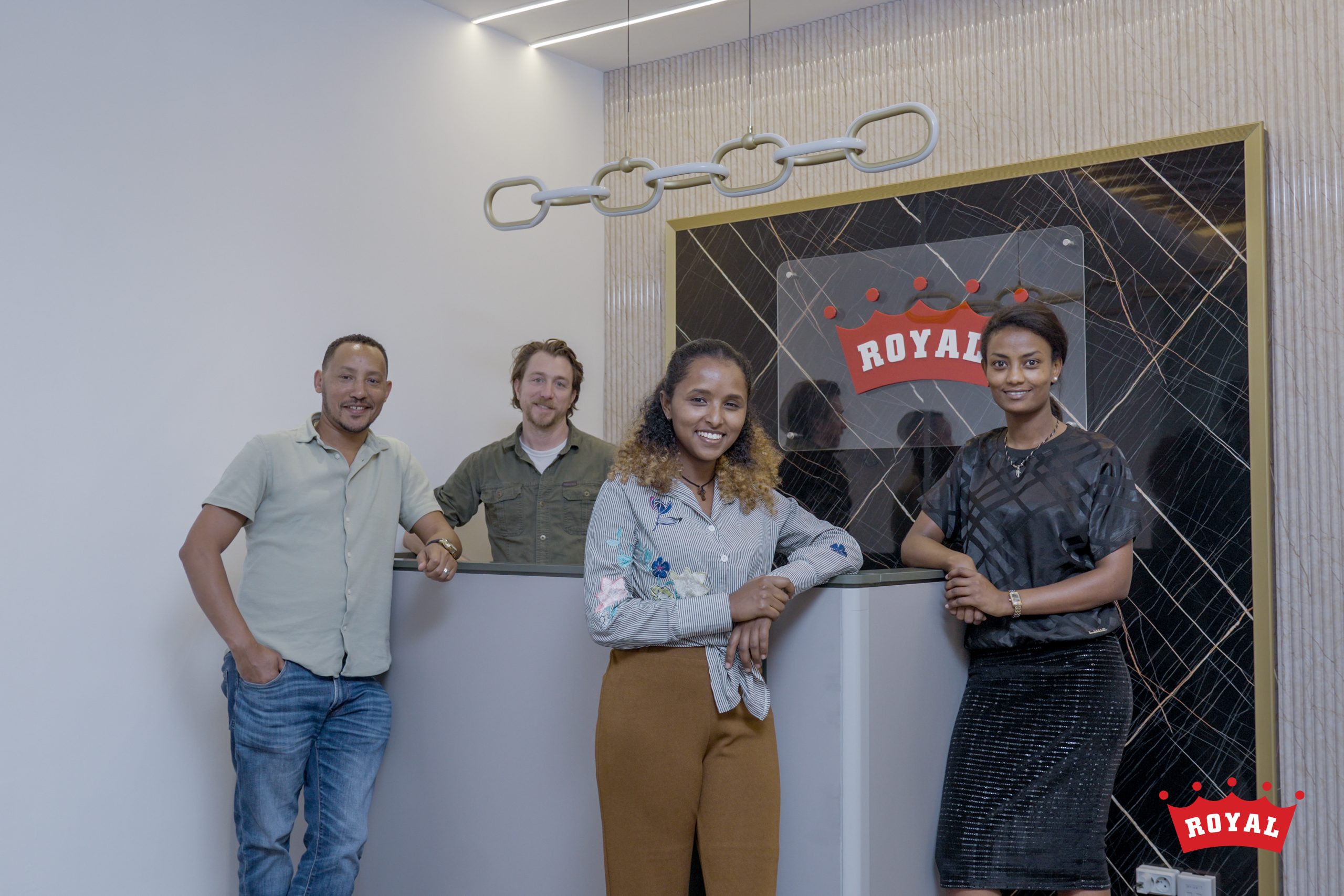
I know I’m lucky, privileged even, when I get a text from Max in early March. “The Addis lab is finished. I’d like to get a trip scheduled for you.” I’m on a plane in two weeks’ time, toting a few coffees, some training materials, and a vague idea of an agenda centered around cupping, data management systems, roasting, and work streams.
The lab is on a high floor of a mall on the corner of a busy roundabout in the Ethiopia-China friendship corridor, just a five-minute drive from the Addis Ababa Bole International Airport. Through the glass doors at the end of a hallway, around a corner from some bank offices and a sleepy security guard, the red Royal logo is unmistakable.
Silently brewing a very strong pour-over (they mock my milder brews, too tea-like, they tell me) in the sample room are the lab’s two newest employees – Segenet Gashaw, QC manager and Q Grader, knowledgeable coffee quality specialist and extraordinary cupper, and Betelhem “Beti” Assefa, the QC assistant, endlessly curious, helpful, always around when you need her.
We spend a week refining sample roasts on an unfamiliar machine (I swallow my pride more than once at blind cuppings) and calibrating on cup score alignment and quality expectations for various grades of Ethiopian beans, and having conversations around quality and value, and diversity of flavor descriptors. Umami was a particularly difficult taste modality for me to describe to the team, until Haile took me to lunch and we shared a bit of shiro – spiced chickpea stew, comfort food – and the answer presented itself.
Ethiopia’s rich diversity of coffee flavors is reflected in the local cuisines – varied regionally and spiced to the precipitous edge of excess – and Haile tests my knowledge after I encourage him to use familiar flavors to describe the coffees he tastes. “What would you think if I described a coffee as kocho.” I wrinkle my nose, tell him I don’t like heavily fermented flavors in coffee but there’s surely someone out there who does. He cracks a smile, later teaches me the word for thank you in Amharic, “āmeseginalehu,” which I spend the rest of the week mispronouncing.
The Lab in Addis, much like the man who runs it, are at the center of any successes Royal will enjoy in Ethiopia. The world’s most important coffee origin is now equipped with a gateway – a facility designed, outfitted, and populated to evaluate and channel earth’s finest beans to eagerly awaiting audiences. It’s also a landing zone, a comfortable space for visitors to meet our team, taste delicious samples, and spend a few minutes collecting themselves on either end of a visit to the coffee farms and stations further afield.
My meeting with Haile was overdue by years, but the regrets of uncomfortably short layovers and other inconveniences of the past faded quickly. The circumstances surrounding our long-awaited meeting were celebratory, and rich with edification and flavor in equal portions. If you haven’t yet, I hope you find the man, and his lab, as effortlessly enjoyable as I did. And if you have met, then you’ll know the kind of excellence and character you can expect when you set foot in his new stomping grounds, Royal Coffee’s lab in Addis Ababa.

Latest Articles by Chris Kornman

Notes Between Cuppings Entry 1
Co-fermented coffee is a new processing approach where producers add natural ingredients like fruit, hops, or spices during fermentation to enhance flavor complexity. Unlike flavored coffee, these additives interact with...
Excerpt: Additive Fermentation: “Infused” Coffee is Gaining Popularity and Sparking Industry Debate”
Co-fermented coffee is a new processing approach where producers add natural ingredients like fruit, hops, or spices during fermentation to enhance flavor complexity. Unlike flavored coffee, these additives interact with...
Are All Green Coffees the Same? Factors That Affect Their Flavor
Explore July 2025 Crown Jewel coffee arrivals from Sumatra, Ethiopia, Tanzania, and more. Bold flavors, innovative processing, and standout producers.