
Article Summary:
Royal Coffee celebrates 30 years importing from Finca La Amistad, Costa Rica’s pioneering organic, shade-grown farm run by Roberto Montero near the Panama border. Fully powered by hydroelectric energy and built on closed-loop composting, the 250-hectare farm is the only Bird Friendly certified estate in Costa Rica. Despite lower yields, it remains a model of sustainable coffee production. The 2025 crop, including the limited “Purple Haze” lot, arrived in February and is competitively priced among Central American organics making now the ideal time to buy or feature this landmark coffee.
Costa Rica Finca La Amistad: Old School Organic
2025 will mark our 30th year importing certified organic coffee from Costa Rica’s Finca La Amistad. To commemorate this anniversary, I visited this pioneering organic farm in January, hosted and guided by farm owner, Roberto Montero, one of the true OGs of the organic coffee movement if there ever was one. Below is my report from the visit.
The Land of Plenty
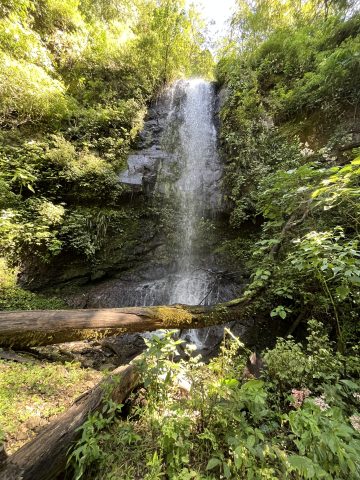
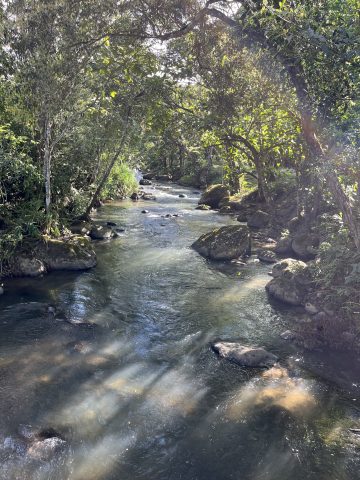
If you are looking for a little slice of Eden in the coffee growing world, I suggest a visit to Finca La Amistad in southern Costa Rica near the border with Panama. Abutting the vast Parque Internacional La Amistad, one of the largest forest reserves in Central America, the farm is a continuation of that protected habitat, producing organically grown coffee on land completely covered by shade trees, with streams and waterfalls laced throughout the parcels, corridors of forest separating sections, and an abundant bird and butterfly population that seem to accompany your every step on the farm. All harvested coffee is both wet and dry milled on the farm, with the energy to run that operation provided by hydropower generated from farm stream flow, and all processing wastes returned to the farm as compost. Amistad is a beautifully enclosed ecosystem in a stunning setting.
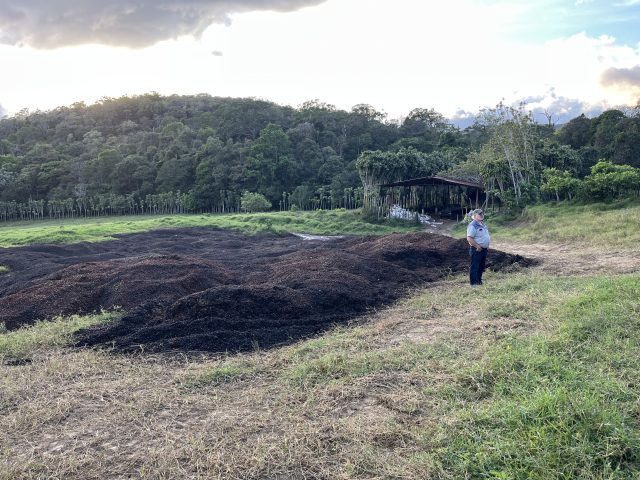
A man and his compost
The Old Family Farm goes Organic
The Montero Zeledon family has been growing coffee on Finca La Amistad (nee Hacienda La Amistad) for over 100 years. Located a short walking distance from the Panamanian border, the family established the farm not long after the border lines were drawn between Panama and Costa Rica in the early 1900’s. In the 1980’s, the farm management fell into the hands of Roberto Montero, the 4th generation of the family on the farm. Not long after taking the reins, Montero made the radical decision to go organic as he witnessed both his and his neighbor’s farms fall victim to the dependence on the agrochemical package of coffee “technification” that had taken over Costa Rica in the 70’s and 80’s. The starkly uniform, shade devoid farms produced prolifically for a few years, but this was inevitably followed by a cycle of low productivity and infestation or disease, as the naked soils were depleted and the lack of biodiversity on the farms provided little defense to pest and fungal invasions. The usual solution at the time was to find another chemical to solve the problem.
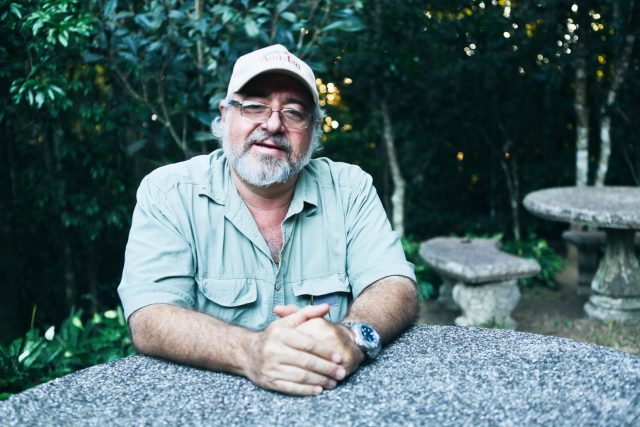
Roberto Montero
Eventually, Montero had seen enough, and in 1989 embarked on the process of converting his farm to organic. It began with soil regeneration through composting of coffee process waste, animal manure, and products from the surrounding forests. The next step was planting shade trees on every parcel of the farm, providing biodiversity, soil protection, and nitrogen and potassium with the leaf litter that is left to decompose on the soil. Weeds and grasses were allowed to grow between the rows and then manually cut and left to decay on the ground adding still more organic matter to the soils. New varieties of coffee were planted and monitored for vigor, production, and resistance to pests and diseases. These organic farming practices are never ending as Montero refines them year after year, improving the composting process and soil nutrition measures, adding more shade trees, and continually replanting with new coffee trees and pruning back old ones.
The transition to organic was not all roses and the farm has had its ups and downs over the years. The trees had to adapt to a life without chemicals, and building up the soil through composting and shade tree leaf litter is a lengthy process. The farm was ravaged by Roya, or leaf rust about 8-10 years ago, as the disease devastated farms from Peru to Mexico, and had to be replanted with a resistant variety that now covers 70% of the farm.
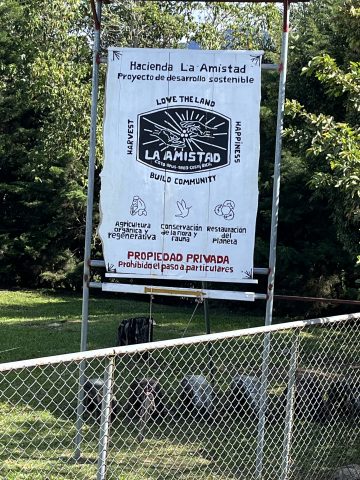
Amistad Today
Finca Amistad is sizeable by any measure. While much of the farm is still in forest cover and some pastureland, there are still well over 250 hectares of planted coffee, ranging in altitude from 1200 meters to 1600 meters. Production is respectable but still only about 1/3 to 1/2 of that of a typical conventional farm in Costa Rica. Apart from the very highest altitude parcels, the entire coffee farm is covered in shade trees, and this year the farm has obtained Bird Friendly Shade Grown certification from the Smithsonian Migratory Bird Council (SMBC), the only farm in Costa Rica to achieve this certification. The coffee at the highest altitude spends most of its time enshrouded in a cloudy mist, turning a dark maroon color as it matures, hence the name “Purple Haze” for the beans grown up on these parcels and sold separately and in limited quantities from the other coffee on the farm.
Every year has its challenges with coffee farming and this year was no different. Heavy rainfall in November and well into December delayed the harvest and disrupted the maturation patterns. Like most of Central America, labor for the harvest has been difficult to obtain, though not as bad as in other parts of Costa Rica. We have contracted 4 containers of the coffee this year, with the first container having just arrived in February. While traditionally one of our higher priced coffees, this year it is relatively reasonable in that regard, now priced very closely to other Central American Organic coffees priced against the ever escalating “C” market.
Amistad and You
If ever there was a year to give Costa Rica Organic Amistad a try, this is the time to do it. Arriving in February, it will be one of the earliest available Central American new crop organic coffees on our roster. While always amongst our highest priced coffees, this year it falls well into the midrange of organic coffee prices, hardly making it an indulgent purchase. Finally, with the new SMBC certification to go with the Organic Certification, you have a coffee to appeal to a wide demographic. This is a lovely coffee from one of the oldest certified organic coffee farms in existence set in a jaw-dropping gorgeous location. If you’ve never bought Costa Rica Organic Amistad, there has never been a better time than the present to jump in and try it. And if you are looking for coffee Nirvana, go visit the farm!
Pura Vida,
John Cossette

Latest Articles by John Cossette

Landmark Pricing Change: Fair Trade and FLO International
John Cossette, Vice President of Green Coffee Purchasing at Royal weighs in on the pricing change and shares his take on our best Fairtrade Organic offerings. Since 1995, Royal Coffee...
Nicaragua and Coffee 2018: Navigating Weather, Civil Strife, Roadblocks, and Low Prices
Nicaragua and Coffee 2018: Navigating Weather, Civil Strife, Roadblocks, and Low Prices (and still delivering great coffee!) After suffering in recent years from loss of production due to the...
Brazil: Beautiful Horizons
When viewing the Royal Coffee offering list for Brazil, it has been traditionally dominated by Mogiana and Cerrado FC SS 17/18, with multiple containers arriving and shipping out to us...