
Crown Jewel Ecuador Pichincha Galo Morales Washed Gesha
Lot 1090 – 35842-1 – SPOT RCWHSE
Boxes 0
Warehouses Oakland
Flavor Profile Strawberry, toffee, blackberry, lemon, and candy
Out of stock
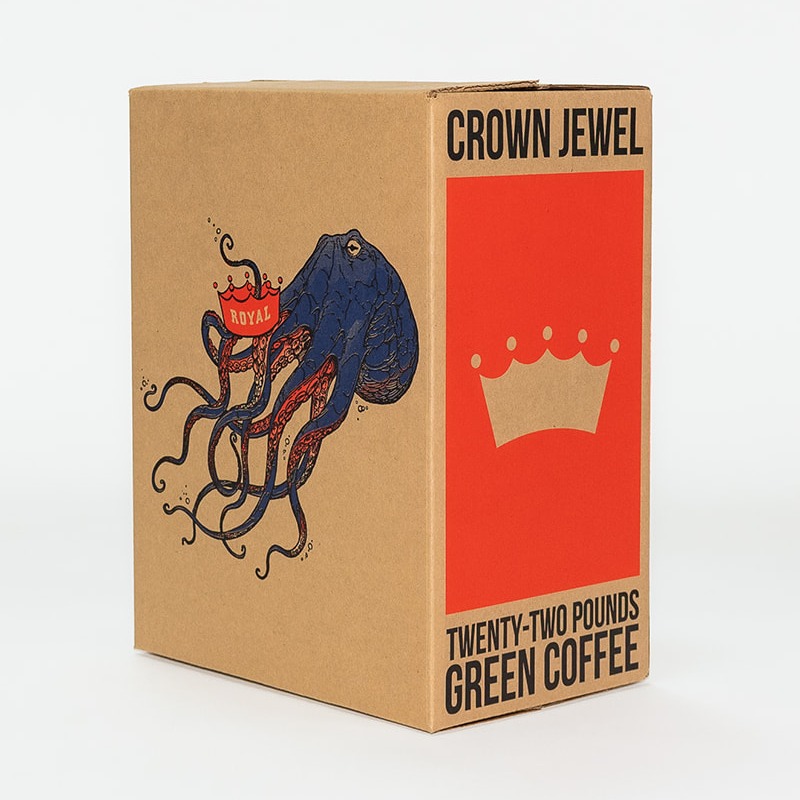
Overview
Overview
This is a low intervention washed Gesha cultivar coffee from Pichincha, Ecuador, produced by Galo Morales Flores and Maria Alexandra Rivera on their farm, Finca Cruz Loma.
The flavor profile is luxuriously floral and lushly fruit forward, with notes of blackberry, lemon, honeysuckle, peach, and a decadent toffee-like sweetness.
Our roasters found the coffee cooperative in the roaster and encouraged heat management during mid-late color change to accentuate the floral notes.
When brewed, our most exhilarating pour-overs were made with a high dose, coarse grind, and long brew time, while espressos at standard ratios also benefited from longer extraction times.
Taste
Taste Analysis by Chris Kornman
That such lush flavors of ripened fruits – I imagine mangos, pineapples, and over-the-sink peaches – can be paired with the fragile and jasmine-like floral notes, so covetously drooled over by coffee cuppers, is no small achievement. The inimitable flavor profile of Galo Morale’s Gesha harvest speaks at once to the duality of its source – impeccable terroir and results-driven processing which extends fermentation just long enough to achieve a near-impossible balance of flavor attractive to professionals and enthusiasts alike. It bridges the ultimate gap between specialist and consumer, and does it with grace and panache.
This is a rare bird, more often sighted from afar than held in hand. Galo Morales’ gambit is nothing short of remarkable. That its value is incontrovertibly signaled by a price tag an order of magnitude above the current, unprecedented highs of commodities futures should come as little surprise. One might go so far as to argue – considering Finca Cruz Loma’s legacy as a multi-award-winning coffee producer (erstwhile admitting that this selection would certainly compete in lockstep with the finest quality coffees anywhere, Best of Panama included) — that this might even be perceived as a bargain, by comparison.
While botanists selected Gesha trees from western Ethiopia’s forests nearly a century ago, 2025 separates us by two decades from its first appearance at a quality competition, 2004’s Best of Panama. In the 20 years since, the cultivar has gained worldwide notoriety and has been planted in nearly every arabica-producing nation. Gesha’s ongoing quest for relevance, in a sea of unconventional processing methods and ongoing discovery and development of new cultivars (like Sidra, Pink Borbon, et al) has often pushed it into new territories of flavor and (in part) due to increased supply, reduced its value from such meteoric heights as it still occasionally enjoys at auction.
By contrast, this coffee’s flavors reflect a refined elegance, restraint, and simplicity, belying its undeniable luxury. It is a delicate indulgence, one which celebrates the improbable and ornate qualities, guided by careful hands and blessed with the advantages of good soil and weather and heirloom tree types, that reverberate echoes of a better possibility – one in which specialty coffees achieve recognizable value throughout an entire convoluted supply chain, and one in which we can equitably share in both pleasure and profit. Alisha Rajan, in the espresso analysis of this coffee, argues that its beauty borders on redemptive. Maybe there is some hope for us, and for coffee, after all. Maybe this cup offers some of the proof.
Source
Source Analysis by Mayra Orellana-Powell & Charlie Habegger
A washed Gesha arrives, by airplane, in the dead of winter. Let us rejoice!
The Crown was made for coffees like this one: rare and difficult to source but something of a benchmark for arabica’s potential at the same time. Galo Morales, for two years now Royal’s sole Ecuador supplier, is one of the very few producers in the world who successfully sells us Geshas. We also air-ship his coffees, which can give them just enough rest to truly peak in flavor when they land in Oakland, but still make the journey vacuum-packed and extremely fresh. This year’s Gesha is silky and tangy with muscat grape, abundant perfume, raspberry, and a hint of anise.
Finca Cruz Loma
Galo Fernando Morales Flores, along with his wife Maria Alexandra Rivera and his extended family, grow coffee on their 350-hectare plot in the community of San José de Minas, a small town in the northwestern part of Pichincha, a short trip north of Quito. They describe their farm, Finca Cruz Loma, as a marvelous paradise whose temperate, tropical climate allows for a huge variety of flora to thrive. The family grows guanábana (soursop), corn, beans, and a plethora of citrus, all in addition to coffee.
The principal harvest months in northern Pichincha are June to September, but Galo and his family continue picking through December. Ecuador’s namesake position on the Earth’s equator means that medium-altitude coffee enjoys practically a perfect year-round growing season, often with flowering and ripe cherry sharing the same branch most months.
Coffee, though always a source of income, has recently brought a lot of recognition for Galo, Maria Alexandra, and the whole family, as winners of Pichincha’s regional quality competition and as featured producers in Ecuador’s national barista competition, both in 2019. In 2020, Cruz Loma took third place in the national “Taza Dorada” quality competition. Across residents and tourists alike Ecuador has a strong domestic market for roasted coffee (part of the reason so little is exported), which means honors such as these have no small impact on a farm’s brand.
Finca Cruz Loma has been in Galo’s family going back 80 years. His grandparents were the first owners, who passed the property to their children, and now he and his four brothers are in charge. Galo’s experience in coffee began 20 years ago working alongside his mother on the farm; he would go on to work professionally in the coffee sector, for exporters and as a project manager, before returning to full-time farming. In Galo’s words, “cultivating my coffee is an activity that allows me to apply and develop the skills and habits I’ve learned over the years; it’s also an essential resource for my family, since my wife, my daughters, and myself are all involved with the production and marketing of our coffee. Everybody in the family has a critical role in the coffee’s success.”
Processing at Cruz Loma
Together, the family oversees four unique processes for their coffee: fully washed; “anaerobic” washed, honey, and natural. This sidra separation was processed as a standard fully washed coffee: cherry was hand-picked and selectively sorted for ripeness and consistency in the field; after depulping the cherry, the parchment was fermented in open tanks for 72 hours, washed clean with fresh water, and then moved to Cruz Loma’s solar dryer where it spent 18-25 days on raised screen beds.
Many times, we look to processing to help us identify attributes in the cup or make sense of what we’re tasting. Extra fermentations, oxygen deprivation, short or long drying times—these will all suggest certain influences on the final coffee. In this case, even with a 72-hour fermentation time, Galo’s washed process for his Gesha is such a straightforward, unremarkable procedure that, delightfully, we really have no choice but to credit the powerful Gesha genetics and Cruz Loma’s terroir for such a result.
green
Green Analysis by Isabella Vitaliano
Luxury knows no bounds, and this Gesha, air-freighted to our Oakland warehouse within days of being prepped for export, has everything you could dream of wanting from a Gesha, and more.
The density is a little bit below average, with an average water activity moisture content. Galo Morales has dialed in his processing and drying techniques like no other. We have found that even slightly older coffee from this producer holds up better than most – a testament to the pristine care taken every step of the way.
Delicate florals are to be handled with a gentle touch in the roaster. Be sure to check out the roaster notes on how to take this coffee to the next level.
Diedrich
Diedrich IR5 Analysis by Doris Garrido
Geshas, without doubt, are very special coffees. They are intensely aromatic, and have pronounced jasmine notes and very delicate flavors. This particular Gesha from Galo Morales has all the exceptional attributes you have heard from this cultivar, very distinctly. Highly enhanced florals, candy like sweetness, and its inherent berry flavor.
For this roast I knew from the green aspects that I need it to do a softer drying, so I opted for a gentle start, increasing the heat after the turning point and then reducing it after the color change. Starting 70% of gas just to look how the coffee behaves, then adding 100% for 2:30 minutes and dropping to 30% at 300F. After color change, airflow began at 50% and was quickly increased to 100% as I observed that I wouldn’t cause a rapid temperature drop. This allowed for a 3:04 minute yellowing phase, which helped develop the floral notes. The coffee began cracking at 378.9F. A1:29-minute development time was used to complete caramelization and achieve the final sweetness.
On the cupping table the sweetness was reminiscent of candied jasmine, ripe peach, starburst candy, strawberry reduction, and bubble gum – very appealing indeed. But also, the cup showcases pineapple, lychee, mango, rose, and blueberries notes along with other tropical fruits. Overall, the coffee presented a delicate floral sweetness and a tangy acidity. This Gesha was quite easy to roast; just be gentle and use some air and it will rewar
Aillio
Aillio Bullet R1 IBTS Analysis by Evan Gilman
Unless otherwise noted, we use both the roast.world site and Artisan software to document our roasts on the Bullet. You can find our roast documentation below, by searching on roast.world, or by clicking on the Artisan links below.
Take a look at our roast profiles below, as they are constantly changing!
A coffee like this requires rapt attention and a willingness to adapt. Simply by reputation, a Gesha coffee pulls in coffeeheads from around the world, sometimes undeservedly. This is not such a coffee. I was able to taste Doris’ roast before I even had my hands on the green, and I was wowed by the sticky florals and complex tropical fruit notes. I wanted to bring out that syrupy stickiness, and I think I succeeded below.
Starting with a relatively low charge temperature of 455F to temper my rate of change, I still wanted to move at a fair clip through green/drying stage for this 500g batch. To that end, I used P9 power until just after turning point, where I decreased to P8. I then waited a little past peak rate of change (38F/min) to increase fan to F3, and finally decreased power to P7 and increased fan further to F4 at 355F / 5:25, where my rate of change usually spikes a bit before first crack. My only other move was to increase fan a little before first crack, and decrease power a little afterwards. Fairly simple moves, and a very cooperative coffee. My drop temperature of 394.6F at 8:18 indicated a quick roast and a just-past-light roast level with 15% of the roast spent in post-crack development.
If you know me, you know I love sweetness in coffee. Particularly caramelized sweetness. This coffee had not only that sugary almond croissant in the background, but also huge complex fruit notes. This isn’t like other Geshas I’ve had the privilege to try. It’s something else, just as delicious and complex. Cherry, cherimoya, fresh fig, and violet come through in this coffee. Berry-like acidity and juicy mandarine citrus too, along with a curious fleeting herbal note that I keep coming back for… licorice? Aniseed?
This coffee is best served as filter drip, in my estimation, but if you’re super extravagant, try an espresso. Regardless of how you prepare it, you’re not going to be disappointed. World class coffee.
Ikawa
Ikawa Analysis by Isabella Vitaliano
Our current Ikawa practice compares two sample roast profiles, originally designed for different densities of green coffee. The two roasts differ slightly in total length, charge temperature, and time spent between color change in first crack. You can learn more about the profiles here.
You’ll be mesmerized by what this luxurious Gesha from Galo Morales. The high density roast of this coffee has lots of cohesive flavors with an particular shine on the florals. While a touch soft, the florals are noticeable and take center stage in this coffee. The light density roast of this coffee is higher in acid with notes like pineapple paired with lilac florals.
Personally, I loved the floral elements combined with the high acidity of the high density roast. It takes all of your attention in a really enjoyable way. Doris preferred all of the florals coming from this coffee in the form of rose and lavender.
I think no matter which direction you take this coffee you’ll love what it has to offer. If you want to let all the florals do the work or you want a punchy, sweet, lilac dream. You’ve got options! We are thrilled to be offering you this Gesha and can’t wait for you to get your hands on it.
Brew
Brew Analysis by MJ Smith
I was hearing rave reviews about this coffee before I even brewed my first cup of it, so I was very excited for the opportunity to work on this brew analysis! And let me tell you, my high expectations were met graciously! This coffee is nearly effortless to brew, meaning that I messed up a few brews and it still tasted great… This coffee has a delightful sweetness, a super smooth body, and a wide range of interesting flavors. I tried brewing it several different ways, but my two favorite brews were both made on conical brewers, with higher doses, coarser grinds, and longer brew times, all contributing to a slightly higher TDS. Let’s get into this coffee!
My first favorite brew was done on a V60 and had a dose of 20g, a grind of 10.5, and a brew time of 4:00. This brew had so much going on (in a good way) and got the entire barista team talking. My tasting notes included strawberry jam, dates, lemon bars, lavender, honey, green gage plum, and powdered sugar. At first, I wasn’t sure about that powdered sugar note, because I got in my head about whether or not powdered sugar had a distinguishable enough flavor to be included, but I was reassured when reading Tim’s tasting notes, where he had also listed confectioners’ sugar. We love a good calibration moment! In fact, I think we were all pretty calibrated on this coffee. We all noticed both strawberry and lemon in some way, shape, or form. Some of the other notes the barista team picked up included honeysuckle, chardonnay, berries and cream, toffee, and different kinds of stone fruit.
The next brew was made on the P90 by Saint Anthony. The recipe was fairly similar to the previous brew, with a 20g dose, 10.5 grind, and a 4:30 brew time. Even with an almost identical brew recipe, the change in brew device and filter type really brought out an entirely different group of flavors. Personally, I tasted notes of honeysuckle, brown sugar, ripe raspberry, dark chocolate, cantaloupe, pomelo, and really good olive oil. Some other notes the barista team found included Mochi muffin, vanilla, powdered sugar, peach, kiwi, milk chocolate, pimento olive, and orange blossom, with a lime finish. Have you ever been to a bookstore that had a cafe inside of it? That’s what drinking this coffee reminds me of. I don’t know how else to describe it. It had an inviting depth, a flavor experience that takes you all around the world, and a coziness that just makes you want to sit in the sun and dive deep into a new book
If you couldn’t already tell, I really, really enjoyed this coffee. To be honest, it had been a while since I was truly WOW’d by a coffee, but this one did just that! To reiterate my recommendations, I enjoyed this coffee the most when it was brewed on a conical brewer, with a higher dose, coarser grind, and longer brew time. I can’t recommend this coffee enough! Don’t miss out!
Espresso
Espresso Analysis by Alisha Rajan
Some say that the world will be saved by beauty. This selection by producer Galo Morales is nothing short of a revelation, so stunning and complex in its presentation that its beauty borders on the redemptive. The simplicity of the production method allows this coffee to sing the praises of Finca Cruz Loma’s terroir as well as an ode to the Gesha cultivar. Almost poetic in nature, this coffee is a true reflection of time and place, flora and fauna, earth and sky. Notes of larger-than-life pineapple and syrupy yellow peaches sing in perfect harmony with toasted almonds and vanilla while a gorgeous florality permeates the entire tasting arch.
I began the espresso analysis with a lower dose of 17.5 grams and used a conservative 1:2 ratio for the extraction. From the very beginning, this espresso was a show-stopper. A medley of pineapple and peach was met with luxurious maraschino cherry on the finish. I increased the dose to further explore the range. My absolute favorite shot came in at an 18.0g dose, 36.8g yield, extracted in 34 seconds. The initial decadence of almond extract and vanilla evolved into the sweetness of ripe yellow nectarines and passionfruit. Florals like jasmine and orange blossom lingered on the palate for an otherwise clean finish.
The other notable extraction came in at an 18.3g dose, 36.3g yield, extracted in 36 seconds. With the most buttery fruit pastry on the nose, this one presented with the most exaggerated canned pineapple and candied peach notes, similar to a pineapple upside down cake. When I shared it with my colleagues, we simply had no words. It was that good. I recommend a medium dose of around 18 grams and a standard 1:2 ratio of dose to yield for the extraction, along with an average 30-35 second extraction time. Doing so will ensure the optimal balance of fruit and floral elements in the coffee.
When we allow beauty to stop us in our tracks, we facilitate our direct and uncensored dialogue with nature. For me, tasting this coffee was completely in line with this experience. It allowed me to experience the land from which it came in the most straightforward yet breathtaking manner. I anticipate that this coffee will carry you on the same journey.
Related Coffee
Hops, lime, botanical, floral, and pink grapefruit
Oakland 27 Boxes
Crown Jewel Colombia Carbonic Honey Cascade Hop Co-Fermented Pink Bourbon Edwin Noreña
37702-1 – SPOT RCWHSE
Hops, lime, botanical, floral, and pink grapefruit
Spot
27 Boxes
$376.84 per box

Green apple, jolly rancher, apple, mojito, apple cider
Oakland 21 Boxes
Crown Jewel Colombia Carbonic Honey Green Apple Co-Ferment Edwin Noreña
37710-1 – SPOT RCWHSE
Green apple, jolly rancher, apple, mojito, apple cider
Spot
21 Boxes
$434.39 per box

Peach, jasmine, peach black tea, grapefruit, and peach nectar
Oakland 49 Boxes
Crown Jewel Colombia Carbonic Honey Peach Co-Ferment Edwin Noreña
37701-1 – SPOT RCWHSE
Peach, jasmine, peach black tea, grapefruit, and peach nectar
Spot
49 Boxes
$376.84 per box
Caramel, grape, jasmine tea, biscoff cookies, and melon
Oakland 7 Boxes
Crown Jewel Yemen Anaerobic Natural Sharqi Haraz Cooperative
37919-1 – SPOT RCWHSE
Caramel, grape, jasmine tea, biscoff cookies, and melon
Spot
7 Boxes
$685.69 per box