
Crown Jewel Colombia Inoculated Carbonic Honey Gesha Edwin Noreña
37695-1 – SPOT RCWHSE
Boxes 0
Warehouses Oakland
Flavor Profile Floral, orange blossom, rose, lemon lime, and pomegranate
Out of stock

Overview
Overview
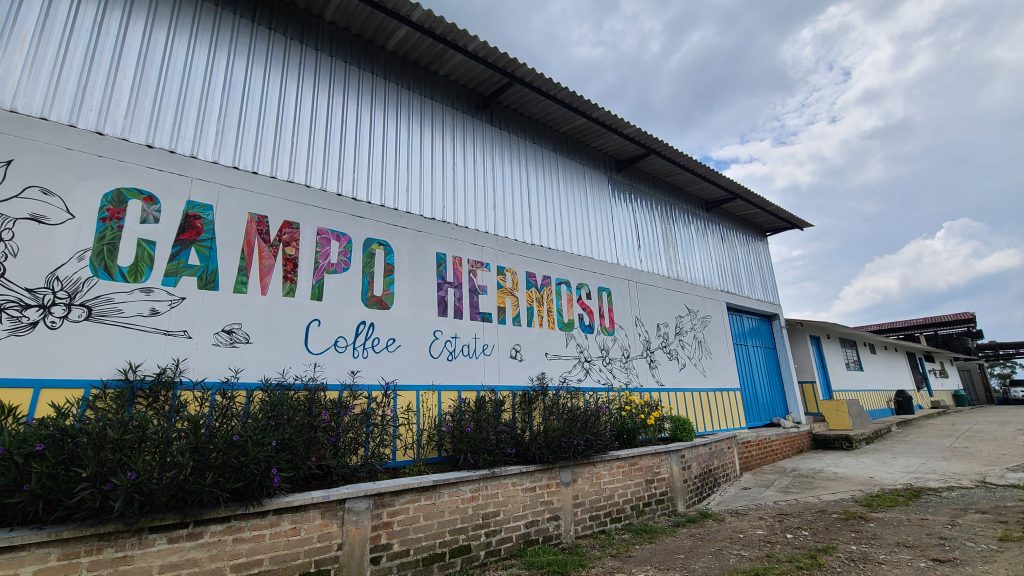
This is a high intervention inoculated carbonic honey process Gesha variety coffee by producer Edwin Noreña on his farm, Finca Campo Hermoso located in Quindío, Colombia.
The flavor profile is intensely botanical, with elegant sweetness and effortlessly silky texture. We taste jasmine and orange blossom, hibiscus and lavender, peaches and pineapples and more.
We employed a classic Gesha style roast for this coffee, using a low charge temperature, giving the coffee a long drying phase, maintaining and controlling the heat during Maillard, and finishing with a short development.
When brewed, we opted for a simple approach to this complex coffee. We recommend a moderate grind and dose for a conical brewer, and a higher dose and coarser grind for a flat bottom brewer to bring out the best balance of fruit and botanicals.
Taste
Taste Analysis by Chris Kornman
Ethereal and evocative, this coffee, sold to us under the clever branding “Gesha Intenso” was love at first taste. It’s exactly what you’d expect and more from a coffee with a storied provenance, an incomparable producer, and an extravagant processing technique. The botanical floral notes are absolutely off the chart: jasmine, orange blossom, bergamot oil, hibiscus, lavender. It really nails the spectrum of the coffee flower bouquet without coming across as perfume-like or artificial. Remarkably, the coffee also has excellent sweetness and structure, with entrancing yet delicate fruit flavors (peach, pineapple, lychee, etc.) and a solid structure – smoothness and grace on the palate.
This is not the first, nor will it be the last time I wax transparently philosophical about the cultivar. We almost decided against this coffee. It felt like an insider’s choice, like something we couldn’t possibly imagine making sense to anyone but an elite few. It wasn’t until Edwin joined us in September as a keynote speaker for Development Stage, and we tasted the coffee with a group of fifty or so attendees, when we realized that not only is this coffee unequivocally exceptional on the cupping table, but it also was entirely enjoyable on its own merits, without bluster or pretense. We were compelled, exhilarated by its possibilities, enchanted by its producer, entranced by its undeniable excellence.
Alisha Rajan, in her brew analysis of this coffee, captures its intrigue inimitably. “Nothing short of revelatory, it bordered on the numinous with its ability to capture the elegance of a Gesha with unbridled sweetness and intensity. The sequential fermentations in processing dial up the volume of the botanicals and vibrant fruit character significantly, making this one of the most complex Geshas I have ever tasted.”
Source
Source Analysis by Charlie Habegger
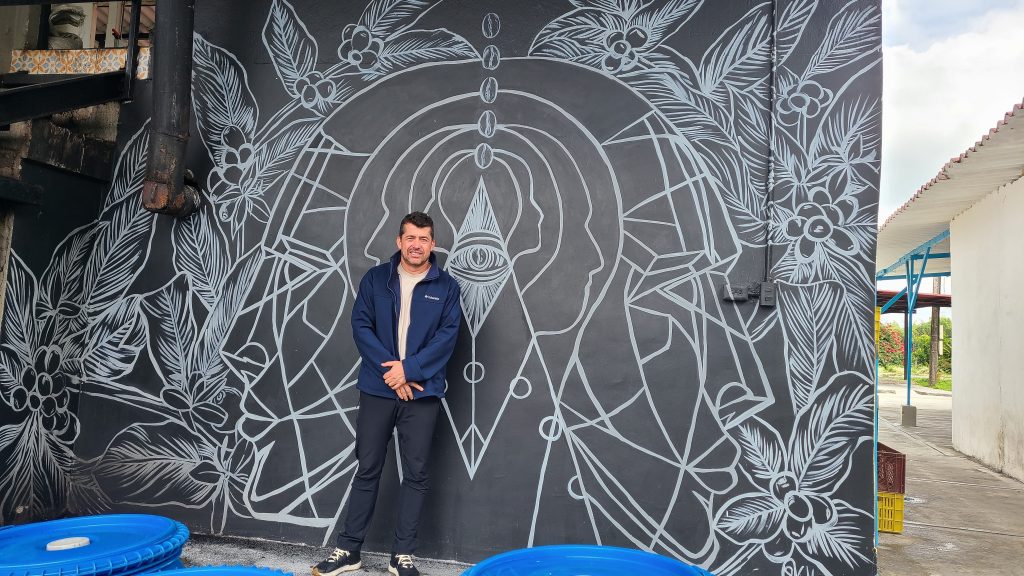
Edwin Noreño is one of Colombia’s true processing obsessives. Known among friends as “El Alquimista” (the alchemist), Edwin has dialed in a wide repertoire of fermentation profiles, often using multiple fermentations in sequence to achieve a desired expression. This honey process microlot was made possible using carefully selected Gesha cherries from his farm, and then fermenting the cherry three distinct times, using the coffee’s own fermentation byproduct—the sticky cherry must—as a flavor “intensifying” agent.
Augmented fermentations and fortified flavor profiles have become Edwin’s specialty in the past few years; however, unlike many other infused or co-fermented profiles produced on Finca Campo Hermoso, this 2-bag Gesha lot uses nothing but the coffee itself in processing.
Quindío Department and Finca Campo Hermoso
For such a naturally gifted department as Quindío, it tends to receive less recognition than others for its coffee. Quindío is Colombia’s second-smallest department by size, making up only about 0.2% of the national territory. It’s location, however, right on the central cordillera of Colombia’s vast Andes divide, and centrally between the country’s largest and most influential cities (Bogotá, Medellín, and Cali), give it a high volume of tourist traffic, coffee industry, airline commuters, and idyllic getaways in the form of brightly painted mountain towns, natural reserves, and high elevation tropical landscapes throughout. Almost the entire department is mountainous, its lowest elevations still over 1000 meters, and many parts are dense with coffee plantations, from the small to the large and ambitious.
Finca Campo Hermoso is a 15-hectare farm outside of Circasia, only a few kilometers north of Quindío’s capital city, Armenia. Its owner, Edwin Noreña, is an agroindustrial engineer by trade with graduate-level studies in biotechnology. Edwin is a well-connected and highly aspirational coffee producer who focuses on pairing very specific cultivars with very specific processing methods designed to express the most surprising, memorable, and delicious coffees possible within his resources. Finca Campo Hermoso concentrates on growing a wide variety of coffee genetics, including pink bourbon, yellow bourbon, yellow caturra, bourbon sidra, gesha, and Cenicafé 1, a resistant hybrid developed by Cenicafé, Colombia’s national coffee research institute. The resulting coffees are often marketed under “El Alquimista”, Edwin’s personal brand for his microlots, which have featured in barista competitions and choosy roasters around the world (and Royal Coffee’s own inventory on an annual basis).
Processing, particularly the fermentation step, always interested Edwin because of its potential to transform raw coffee seeds into a remarkably unique sensory experience for coffee drinkers. A breakthrough moment for him was realizing that the sugary, residual liquid produced during the fruit fermentation (known as the must in winemaking) could be used again in subsequent fermentations to add natural sugars, and also serve as a solvent for flavoring agents. Over the years Edwin has co-fermented with chilis, ginger, fruit, and brewer’s hops to develop unique flavors in his microlots. This lot, on the other hand, is all coffee.
Honey Intense Process
You know you’re writing about a complicated process when you need to start with an abstract. Here goes. Edwin’s processing for this particular lot involved three distinct whole cherry fermentations before the coffe was honey processed: one of fresh picked cherry on its own; a second one with more intentional oxygen deprivation; and a third one in which the cherry was accompanied by the coffee cherry must (a biproduct of the second fermentation) which had been pre-fermented on its own. Finally, the thrice-fermented cherry was depulped and moved immediately to raised screen beds to dry, just like a traditional dark honey would be. Each stage adds a particular bit of uniqueness to the final coffee, so that by the end the coffee is truly one of a kind in the world.
The first fermentation was with fresh coffee cherry only, carefully hand-sorted for ripeness and consistency, washed clean, and immediately moved into covered tanks to ferment for 24 hours with limited oxygen. Some consider this kind of step to be a “pre-fermentation” because the coffee is not fully fermented; rather, the coffee fruit becomes dramatically softer, sweeter, and more acetic as the flesh begins to overripen and break down.
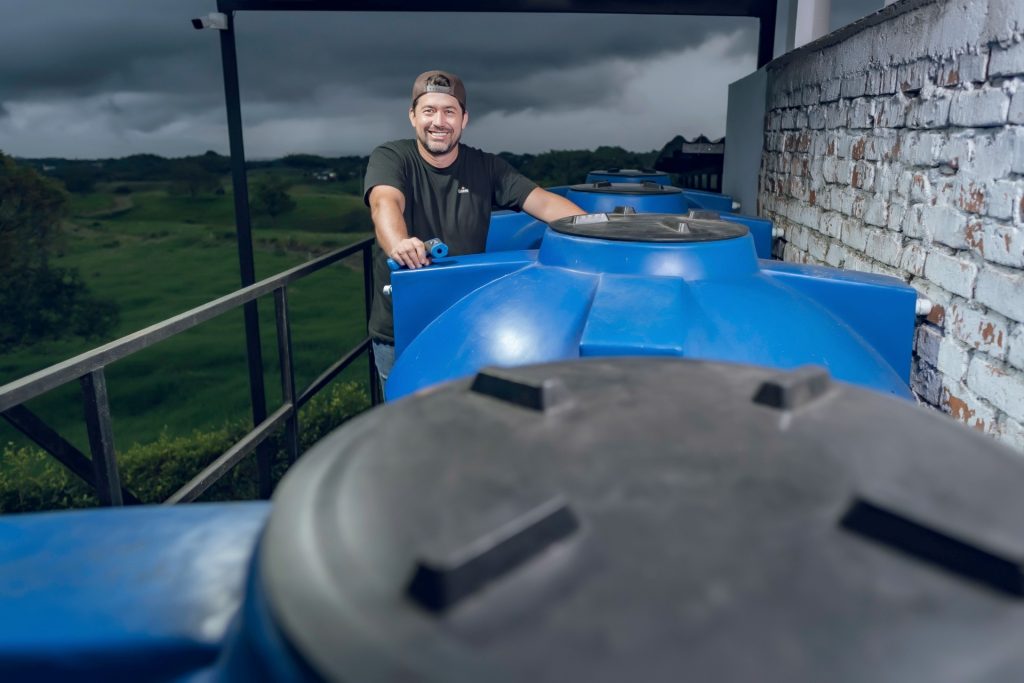
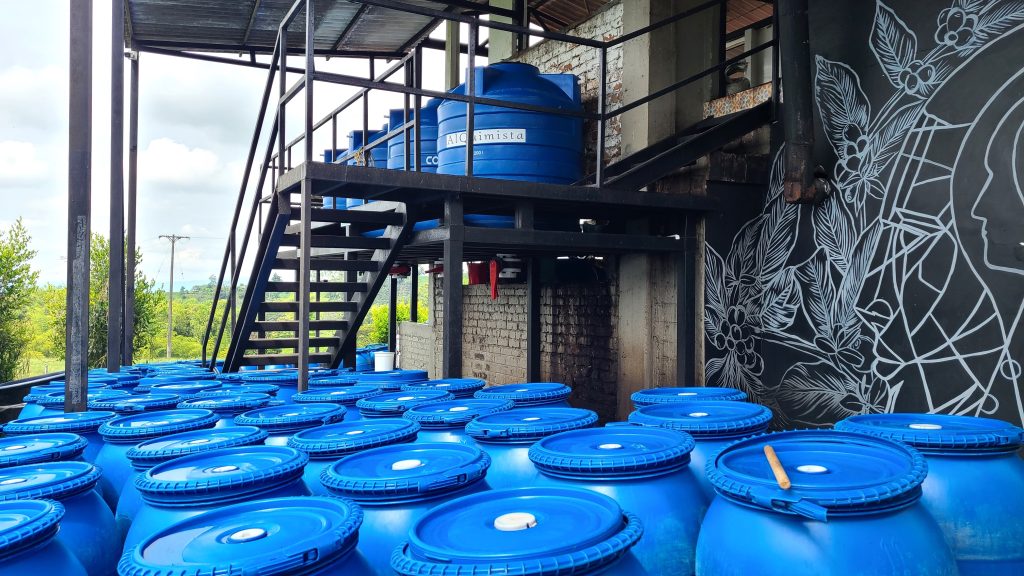
Once the first, short fermentation was complete the cherries were moved into 2000kg tanks for a second, fully oxygen deprived, fermentation. This type of treatment is known as “carbonic maceration”, since the oxygen is pushed out a one-way valve leaving the cherry to sit surrounded by its own carbon dioxide instead. During this phase the cherry leaches out a concentrated sticky, sugary runoff, called the mossto or “must”, not unlike the must from freshly smashed grapes and skins in winemaking.
After the second fermentation was complete, the cherry was separated from its must and moved into much smaller tanks, of 200kg capacity each. The must was then fermented on its own, along with brewer’s yeast to inoculate the process. The fermented must was then mixed into the coffee cherry, at a ratio of 30mL per kilogram. The cherry and must were sealed together into the smaller tanks to ferment a third time for another 72 hours.
In the final step the fermented cherry was lightly depulped leaving most of the mucilage intact (similar to what a “black” honey would be in Costa Rica), and moved directly to Edwin’s greenhouse to dry on raised screen beds, where it dried for 10 days.
Like all microlots at Campo Hermoso, the final fully dried coffee was conditioned for 8 days in a warehouse, allowing for humidity to stabilize inside the seeds, and then moved into GrainPro bags for long-term storage, where it was cupped numerous times over the next few weeks for quality analysis.
Green
Green Analysis by Chris Kornman
A classically long-berry shaped green coffee, with Gesha’s signature squiggle center cut, this is an aromatic green with strong hints of botanicals, herbs, spices, and flowers—all the more impressive knowing that, while high-intervention in processing style, there was no additional co-fermentation ingredient used to enhance the flavor beyond what yeast inoculation and carbonic maceration brought to the table.
The green is narrow and long, and much of it passed through the top two screens despite being somewhat large in appearance. This bean shape also affects density, which measures here as moderately high but I’d expect displacement to reveal an even higher gram per liter numerator. Moisture content and water activity are both within expected ranges. Check Doris’ notes for her Gesha-style approach to this unique, intense offering.
Gesha, of course, is an Ethiopian cultivar. The short version of the story goes like this: Somewhere close to the town of Gesha in remote western Ethiopia’s Bench Maji Zone, British agents picked and transported coffee from the forests around Kaffa to Kenya in 1931, and seeds from these trees were then sent to Uganda and Tanzania in 1936. Collections in these countries populated fields and research stations in Malawi and Costa Rica, and eventually Panama… where the cultivar was “rediscovered” at an auction in 2004. Its flavor impressed judges and buyers alike and there the plant continues to produce award-winning flavors and garner record-breaking prices.
Diedrich
Diedrich IR5 Analysis by Doris Garrido
In Latin America it was popular for people to write poetry on street walls, like graffiti style, so the other day I read one that said: I used to be an atheist, until I tasted that Gesha, and I didn’t know who to thank!
And I totally identified with the phrase. I’m a fanatic of rainbow flavors, and in this coffee world, I have developed a deep love for delicate and botanical aromas. And as usual, whenever we have a Gesha, I get overly excited -first to taste the possibilities on the sample roast and then to practice the Chris Kornman lessons to make the gesha out of it.
So, for this roast, I aimed to start with a low charge temperature, give the coffee a long drying phase, maintain and control the heat during Maillard, and finish with a short development.
To begin, I warmed up the roaster just below 400F charging the coffee when the temperature hit 396F. I then observed how the coffee reacted to the initial heat and decided to wait 3 minutes to add the 70% gas. Later, I increased it to 100% and let it run until minute 6, when I dropped it to 30%. The color change occurred around 300F. At that point, entering the Maillard phase, I cranked the airflow to full and waited for the first crack.
With these adjustments, I reached yellowing at 3 minutes and 16 seconds and noticed the coffee started cracking when the temperature marked 380F. I usually aim for short developments when roasting Geshas, but in this case, I wanted to stretch just a hair more, to compliment the yellowing and caramelize a touch more. I ended up dropping the coffee at 398F. The total roast time was 10 minutes and 24 seconds -a relatively long drying phase that allowed me to work the Maillard and get the intense orange blossom.
On the cupping table, this was not my usual Gesha, it was intense, vibrant, bursting with high botanical notes. The taste was very lemony, with remarkable bergamot, a very sweet and citrusy bergamot from Berkeley Bowl, I may say. Alongside hints of hibiscus, lemongrass, lychee, and ginger. Josh calls for coconut, Chris for Angel food cake, and I agree with all of them. This coffee is full of flavors that I am not used to in a Gesha, and that was when I remembered, this is an Inoculated Carbonic Colombia Gesha from Edwin Norena campo Hermoso farm, so my answers were there.
I still don’t know who to thank Geshas but for this particular one Edwin and Mother Earth is a good start!
Brew
Brew Analysis by Alisha Rajan
After eager anticipation, we had the pleasure of meeting Edwin Norena not too long ago during our annual coffee symposium at the Crown. We were star struck, even more so due to his kind and affable nature, his genuine inquisitiveness, and his willingness to share his gifts with us. It’s not every day you encounter a coffee deity! All jokes aside, this high intervention Gesha is everything one would expect it to be as the handiwork of the Alchemist. Nothing short of revelatory, it bordered on the numinous with its ability to capture the elegance of a Gesha with unbridled sweetness and intensity. The sequential fermentations in processing dial up the volume of the botanicals and vibrant fruit character significantly, making this one of the most complex Geshas I have ever tasted.
My approach to the brew analysis was one of simplicity because I knew the coffee would speak for itself. One of my favorite brews happened to be my first one. I used a V60 brewer with an EKS43 grind size of 9 and a dose of 18.0g to yield a 1:16.67 extraction ratio in 3 minutes and 33 seconds. The unmistakable floral overtures were present in the aroma as well as flavor, along with powerful lychee, pineapple, lemon-lime citrus, and peaches n’ cream.
As an alternative profile, I opted to use a flat bottom brewer to bring about a more full-bodied iteration of this coffee. Using a Kalita Wave for this brew, I set the EKS43 grind size to 11 and dosed at 19.0g for a ratio of 1:15.79 and extraction time of 3 minutes 19 seconds. The extraction percentage was quite a bit higher, but I had reached an optimal syrupy consistency that complemented the flavor profile very well. This one was heavy on the cherry, rose and orange blossom florals, pink lemonade, boozy raspberry, pineapple upside down cake, and creamy earl grey. It was a truly stunning and layered tasting experience. Overall, I recommend a moderate grind and dose for a conical brewer, and a higher dose and coarser grind for a flat bottom brewer to bring out the best balance of fruit and botanicals.
Edwin’s work often reminds me of the magician archetype. The magician is a symbol of concentrated power, resourcefulness, and an abounding creativity that bridges the divide between the earth and the heavens. He knows how to amplify the natural treasure that lies before him, which I believe is a very apt metaphor for how this coffee has been processed. I hope you are as enchanted by it as I am.
Related Coffee
Hops, lime, botanical, floral, and pink grapefruit
Oakland 27 Boxes
Crown Jewel Colombia Carbonic Honey Cascade Hop Co-Fermented Pink Bourbon Edwin Noreña
37702-1 – SPOT RCWHSE
Hops, lime, botanical, floral, and pink grapefruit
Spot
27 Boxes
$376.84 per box

Green apple, jolly rancher, apple, mojito, apple cider
Oakland 21 Boxes
Crown Jewel Colombia Carbonic Honey Green Apple Co-Ferment Edwin Noreña
37710-1 – SPOT RCWHSE
Green apple, jolly rancher, apple, mojito, apple cider
Spot
21 Boxes
$434.39 per box

Peach, jasmine, peach black tea, grapefruit, and peach nectar
Oakland 49 Boxes
Crown Jewel Colombia Carbonic Honey Peach Co-Ferment Edwin Noreña
37701-1 – SPOT RCWHSE
Peach, jasmine, peach black tea, grapefruit, and peach nectar
Spot
49 Boxes
$376.84 per box
Caramel, grape, jasmine tea, biscoff cookies, and melon
Oakland 7 Boxes
Crown Jewel Yemen Anaerobic Natural Sharqi Haraz Cooperative
37919-1 – SPOT RCWHSE
Caramel, grape, jasmine tea, biscoff cookies, and melon
Spot
7 Boxes
$685.69 per box