
Crown Jewel Colombia Carbonic Honey Peach Co-Ferment Edwin Noreña
37709-1 – SPOT RCWHSE
Boxes 0
Warehouses Oakland
Flavor Profile Peach, jasmine, peach black tea, grapefruit, and peach nectar
Out of stock


Overview
Overview
This is a high intervention carbonic honey process coffee, co-fermented with peaches by producer Edwin Noreña on his farm, Finca Campo Hermoso located in Quindío, Colombia.
The flavor profile is, unsurprisingly, very peachy! Its hallmarks are extraordinary jelly or gummy-candy-like sweetness, floral aromatics, and strong flavors of stone fruits, including peaches, apricots, and nectarines.
Our roasters found applying full power through the middle phase, then easing off and finishing with full airflow will result in a smooth, candy-sweet, aromatic cup.
When brewed, we recommend a lower dose and a cone brewer to really bring out the sweetness.
Taste
Taste Analysis by Isabella Vitaliano
This past September, The Crown hosted a two-day symposium called Development Stage. During the event, Edwin norena spoke at the event and attendees got to take a closer look at his process and how he views coffee production. It was an exciting time to take a sneak peek into the mastermind behind “El Alquemista”. When you meet him, you’ll find he is down to earth, has a soft demeanor and is unconcerned of the buzz around him being there.
Sourcing the peach mossto lot for the first time from Edwin, we are thrilled. It is just as high of caliber as his other coffees. This sort of name certainly hits all of the buzz words your marketing team could froth over, but it also has the taste to back it up. Extremely sweet in the cup, think jelly, honeydew, peach nectar, peach (of course) and apricot jam. The processing really encouraged this sort of starburst-like flavor with more curious notes of yuzu, coconut milk, basil, and sweet cream.
Source
Source Analysis by Charlie Habegger
Edwin Noreña is one of Colombia’s true processing obsessives. Known among friends as “El Alquimista” (the alchemist), Edwin has dialed in a wide repertoire of fermentation profiles, often using multiple fermentations in sequence to achieve a desired expression. This honey process microlot was made possible using two careful and distinct full cherry fermentations, the second of which was heavily fortified and infused. The result is an effusive cup with jasmine florals and flavors of fruit gummies, watermelon jelly, maple syrup, and pink lemonade. It’s fun, sophisticated, totally delicious, and not at all as cartoonish as it may sound.
Quindío Department and Finca Campo Hermoso
For such a naturally gifted department as Quindío, it tends to receive less recognition than others for its coffee. Quindío is Colombia’s second-smallest department by size, making up only about 0.2% of the national territory. It’s location, however, right on the central cordillera of Colombia’s vast Andes divide, and centrally between the country’s largest and most influential cities (Bogotá, Medellín, and Cali), give it a high volume of tourist traffic, coffee industry, airline commuters, and idyllic getaways in the form of brightly painted mountain towns, natural reserves, and high elevation tropical landscapes throughout. Almost the entire department is mountainous, its lowest elevations still over 1000 meters, and many parts are dense with coffee plantations, from the small to the large and ambitious.
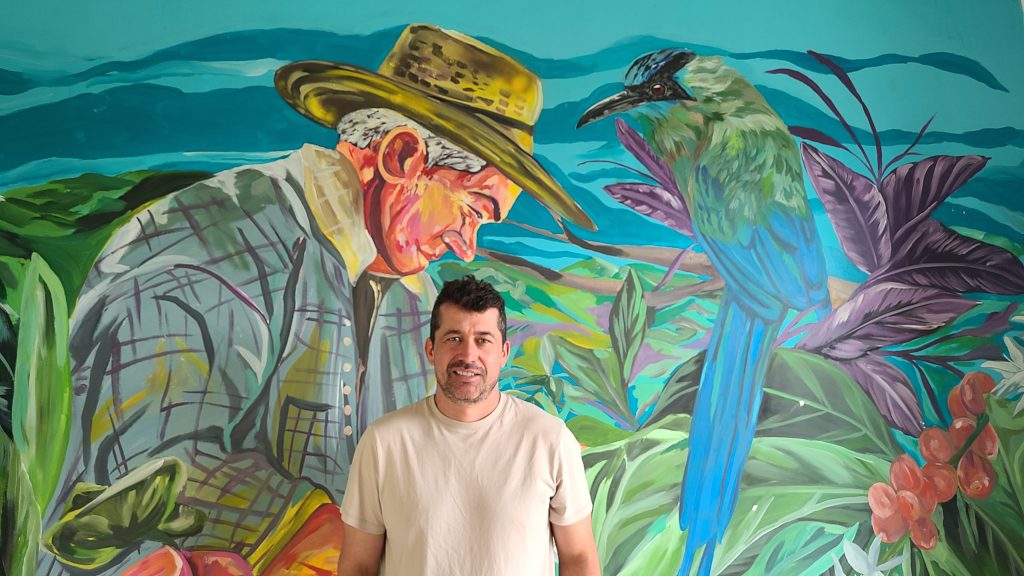
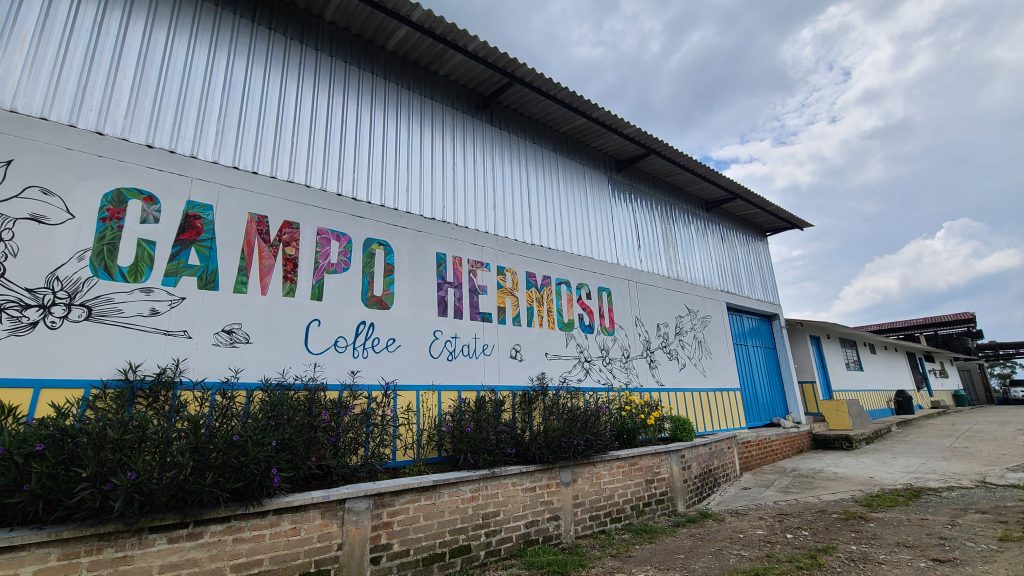
Finca Campo Hermoso is a 15-hectare farm outside of Circasia, only a few kilometers north of Quindío’s capital city, Armenia. Its owner, Edwin Noreña, is an agroindustrial engineer by trade with graduate-level studies in biotechnology. Edwin is a well-connected and highly aspirational coffee producer who focuses on pairing very specific cultivars with very specific processing methods designed to express the most surprising, memorable, and delicious coffees possible within his resources. Finca Campo Hermoso concentrates on growing a wide variety of coffee genetics, including pink bourbon, yellow bourbon, yellow caturra, bourbon sidra, gesha, and Cenicafé 1, a resistant hybrid developed by Cenicafé, Colombia’s national coffee research institute. The resulting coffees are often marketed under “El Alquimista”, Edwin’s personal brand for his microlots, which have featured in barista competitions and choosy roasters around the world (and Royal Coffee’s own inventory on an annual basis).
Processing, particularly the fermentation step, always interested Edwin because of its potential to transform raw coffee seeds into a remarkably unique sensory experience for coffee drinkers. A breakthrough moment for him was realizing that the sugary, residual liquid produced during the fruit fermentation (known as the must in winemaking) could be used again in subsequent fermentations to add natural sugars, and also serve as a solvent for flavoring agents. Over the years Edwin has co-fermented with chilis, ginger, brewers hops, and, in this case dehydrated fruit, to develop unique flavors in his microlots.
Peach Mossto Co-Fermented Process
You know you’re writing about a complicated process when you need to start with an abstract. Here goes. Edwin’s processing for this particular lot involved two distinct whole cherry fermentations: one of fresh picked cherry on its own; and a second one in which the cherry was accompanied by a carefully formulated solution of coffee cherry must (a biproduct of the first fermentation) and dried fruit. Finally, the twice-fermented cherry is depulped and moved immediately to raise screen beds to dry, just like a traditional honey would be. Each stage adds a particular bit of uniqueness to the final coffee, so that by the end the coffee is truly one of a kind in the world.
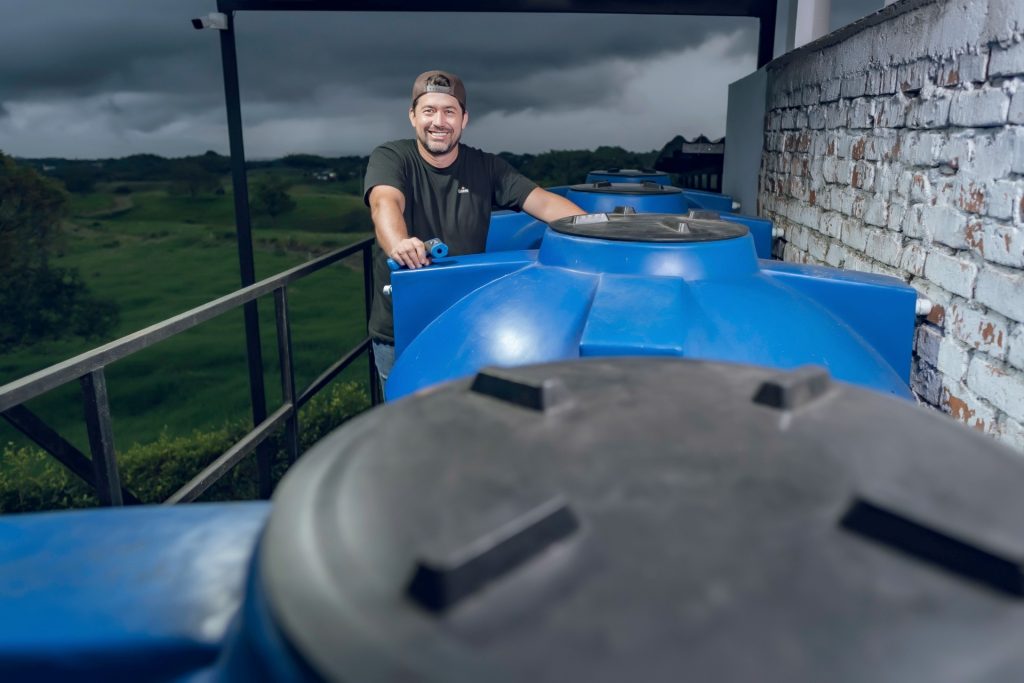
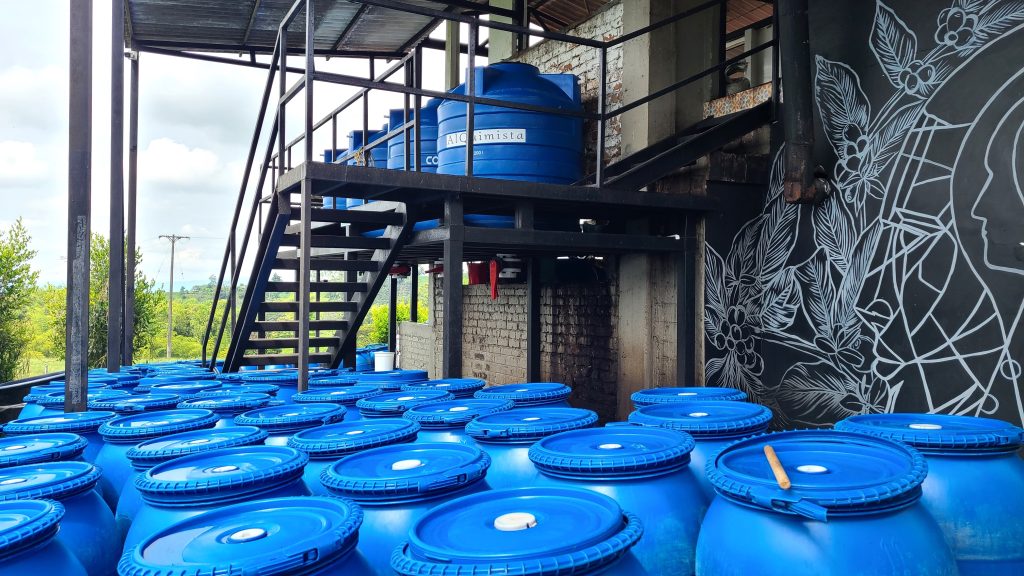
The first fermentation was with fresh coffee cherry only, carefully hand-sorted for ripeness and consistency, washed clean, and immediately moved into 2,000kg tanks to ferment for 24 hours with limited oxygen. During a fermentation like this (which we would consider an “anaerobic maceration” of the cherry) the fruit becomes dramatically softer, sweeter, and more acetic, while also leaching out a concentrated sticky, sugary runoff, the mossto or “must”, not unlike the must from freshly smashed grapes and skins in winemaking.
After this first fermentation was complete, the fermented cherry was separated from its must and moved into much smaller tanks, of 200kg capacity each. The must was then fermented on its own, along with brewer’s yeast to inoculate the process and ample quantities of dried fruit for flavoring. The fermented and flavored must was then mixed into the coffee cherry, at a ratio of 10mL per kilogram. The cherry and must were sealed into the smaller tanks to ferment again for 72 more hours.
In the final step the fermented cherry was lightly depulped leaving most of the mucilage intact (similar to what a “black” honey would be in Costa Rica) and moved directly to Edwin’s greenhouse to dry on raised screen beds, where it dried for 10 days.
The fully dried coffee is then conditioned for 8 days in a warehouse, allowing for humidity to stabilize inside the seeds, and then moved into GrainPro bags for long-term storage, where it is cupped numerous times over the next few weeks for quality analysis.
Edwin used a high-quality cultivar here but still a very common one: caturra is considered a “classic” Colombia genetic, having dominated much of the landscape prior to the coffee rust outbreaks of the 2010s. In other words, the arabica genetics themselves are not exotic to Colombia. Rather, the achievement is in the husbandry of the trees, the harvesting, precise blend of the different cherries, and of course the very exacting processing approach created entirely by Edwin. Some “experimental” coffees scream their processes crudely in the cup; the best ones are so symphonic as to seem effortless, the way a well-made bonsai tree can be both a specimen of nature and a monument to an extraordinary amount of work, study, and concentration.
Green
Green Analysis by Isabella Vitaliano
A peach co-fermented lot has blessed us with its presence. I always expect the green to be a little bit wonky but we have normal specs all around. A wider screen size spread paired with a very low density makes it ideal for gentle roasting. Moisture content is in the ideal range with water activity sitting a little bit higher than average. On first opening this coffee you’ll notice a strong peaches and cream aroma, candy like scent alone. When roasting you get even more delicious aromas coming from it.
Caturra, natural mutation of the Bourbon cultivar is known for it’s good yield potential but also has high susceptibility to coffee leaf rust. First discovered in Brazil, a single gene mutation causes the plant to grow smaller. Due to its size, producers can plant more in one area and have an easier time spraying the plants with different treatments as needed. Castillo replaced a lot of Colombia’s Caturra in just a few years of dispersal, which created some panic in specialty. Caturra is still considered a kind of ‘original’ cultivar that Colombia did well with prior to rust. It’s still widely planted but not dominant as before.
Diedrich
Diedrich IR5 Analysis by Doris Garrido
From finca Campo Hermoso, we received a Caturra with a high-intervention honey process, co-fermented with peach. Considering its low density and average moisture, I decided to roast this coffee slowly and gently, aiming for an average time roast of 9 minutes.
I preheated the roaster to 390F and started the roast with 70% gas during the first 30 seconds.
After turning point, I cranked the gas to 100% at the 2-minute mark. I kept the gas at 100% until 4:30, then dropped it to 30%. The color change started earlier, which seems to happen more often with high-intervention process coffees.
For the rest of the roast, I added full airflow and watched as it approached the first crack and developed the coffee for a minute and thirty seconds. 399F was the end temperature and the roast duration was 9:29 minutes. The final cup was not only aromatic but also presented a silky sweetness. With notes of coconut milk, candy, gummy, honeydew, peach and creamy starburst- like candy.
Overall, it reminded me of a juicy orange creamsicle or fruity punch. I’d call it dessert in a cup.
IKAWA
Ikawa Pro V3 Analysis by Isabella Vitaliano
Our current Ikawa practice compares two sample roast profiles, originally designed for different densities of green coffee. The two roasts differ slightly in total length, charge temperature, and time spent between color change in first crack. You can learn more about the profiles here.
Peach cobbler, lemonade, orange marmalade; this coffee is out of this world with bombastic fruit notes. We found that on the high-density roast of this coffee there was more like coconut milk and starburst. For the low-density roast there were more creamsicle and soft honey dew flavors. This coffee is hard to mess up in that, no matter how you roast it, you are guaranteed to get some peach flavors. There are certain tricks to getting more nuanced cups, Be sure to check out the roasters’ notes for more details.
You can roast your own by linking to our profiles in the Ikawa Pro app here:
- Roast 1: Low Density Sample Roast
- Roast 2: High Density Sample Roast
Brew
Brew Analysis by Katie Briggs
We are soaking up the last few warm days here in the bay area, and this honey peach co-ferment is the perfect send off into the fall season. With sweet complexity, soft acidity and the peach really coming through, this coffee feels more like a nice peach flavored black tea in the summertime. Here are some brews I did of this coffee to get it tasting just right!
I started out with a dose of 19 grams of coffee and ground it at a 10 and brewed it on a V60 cone brewer. I did an initial pulse of 50 grams of water and let it bloom for 40 seconds. I then did another pulse of water up to 200 grams, and then the final dose up to 300g. This first brew was okay, it did taste a bit heavy, so I wanted to fix that on the next brew. We got notes of peach rings, black tea, and hibiscus.
I wanted the next brew to be a lot softer, so I decided to down dose to 18 grams for the next one. I did the brew on the same V60 cone brewer and did the same water pulses. This one turned out much better! We got notes of peach black tea, lemon, and jasmine. I liked this one a lot but wanted to see if I could get it just a little more sweet and delicate.
So for this next brew, I did the same as the last essentially, except I ground it at a 10.5. I liked this brew a lot as well! I got a lot more of that sweetness I wanted. We got notes of strawberry, lemon zest, caramel, and peach tea. This was definitely the brew I was looking for! I did one more of this same brew on the Kalita Wave flatbed brewer just to see how it would do, but it brought that heaviness back into it and I was not a fan.
All in all this is such a fun coffee! I think these fruity fun co-ferments would be so good as iced coffee, but either way you enjoy it will be a good time. I would recommend a lower dose and a cone brewer for this coffee to really bring out the sweetness. The perfect coffee for the transition to the fall season! Cheers!
Espresso
Espresso Analysis
This sure is a unique coffee, and based on my experience with co-ferments, this one performed beautifully as an espresso. Often when brewed as espresso, complex co-ferments can feel a little one trick pony. In this case, the peach of it all, while surely present, wasn’t rubbing our noses in it. There were many lovely notes bolstering this coffee above and beyond it’s peachy roots.
For our first recipe with a dose of 17.8grams, a yield of 42grams, and coming in at 25 seconds, this was a real stunner. Before even tasting it, my nose was detecting luscious notes of bananas foster and molé. On the tongue, I was getting more delicate and subtle notes like jasmine, black currant, all with a slight effervescence that reminded me of how a ripe kiwi tickles the tongue.
This second recipe was a bit more bright and summery, weighing in at 16.8grams, yielding 37grams and taking 24 seconds. This dial was jam-packed with fruity, juiciness. To me, it smelled exactly like the ‘Pacific Cooler’ Capri Sun and tasted like lemon meringue and orange blossoms. There was also a lovely under taste of almonds and butter, which brought smoothness in droves. Light botanical top notes danced lithely above the whole scene, think; tarragon and pomegranate.
I thoroughly enjoyed working with this coffee, it surprised me in a good few ways, I will say, I tried a few shots at a higher dose (18.5g<) and it was tasting a bit bitter and chemical in that range, so if I had any directional take away from this experience, I would say start with a lower dose. Anywho, happy dialing!
Related Coffee
Hops, lime, botanical, floral, and pink grapefruit
Oakland 27 Boxes
Crown Jewel Colombia Carbonic Honey Cascade Hop Co-Fermented Pink Bourbon Edwin Noreña
37702-1 – SPOT RCWHSE
Hops, lime, botanical, floral, and pink grapefruit
Spot
27 Boxes
$376.84 per box
Green apple, jolly rancher, apple, mojito, apple cider
Oakland 21 Boxes
Crown Jewel Colombia Carbonic Honey Green Apple Co-Ferment Edwin Noreña
37710-1 – SPOT RCWHSE
Green apple, jolly rancher, apple, mojito, apple cider
Spot
21 Boxes
$434.39 per box

Peach, jasmine, peach black tea, grapefruit, and peach nectar
Oakland 49 Boxes
Crown Jewel Colombia Carbonic Honey Peach Co-Ferment Edwin Noreña
37701-1 – SPOT RCWHSE
Peach, jasmine, peach black tea, grapefruit, and peach nectar
Spot
49 Boxes
$376.84 per box
Caramel, grape, jasmine tea, biscoff cookies, and melon
Oakland 7 Boxes
Crown Jewel Yemen Anaerobic Natural Sharqi Haraz Cooperative
37919-1 – SPOT RCWHSE
Caramel, grape, jasmine tea, biscoff cookies, and melon
Spot
7 Boxes
$685.69 per box