
Crown Jewel Colombia Double Fermented and Washed Java Huila
35998-1 – SPOT RCWHSE
Boxes 0
Warehouses Oakland
Flavor Profile Chocolate, toffee, orange, nectarine, and peach
Out of stock


Overview
Overview
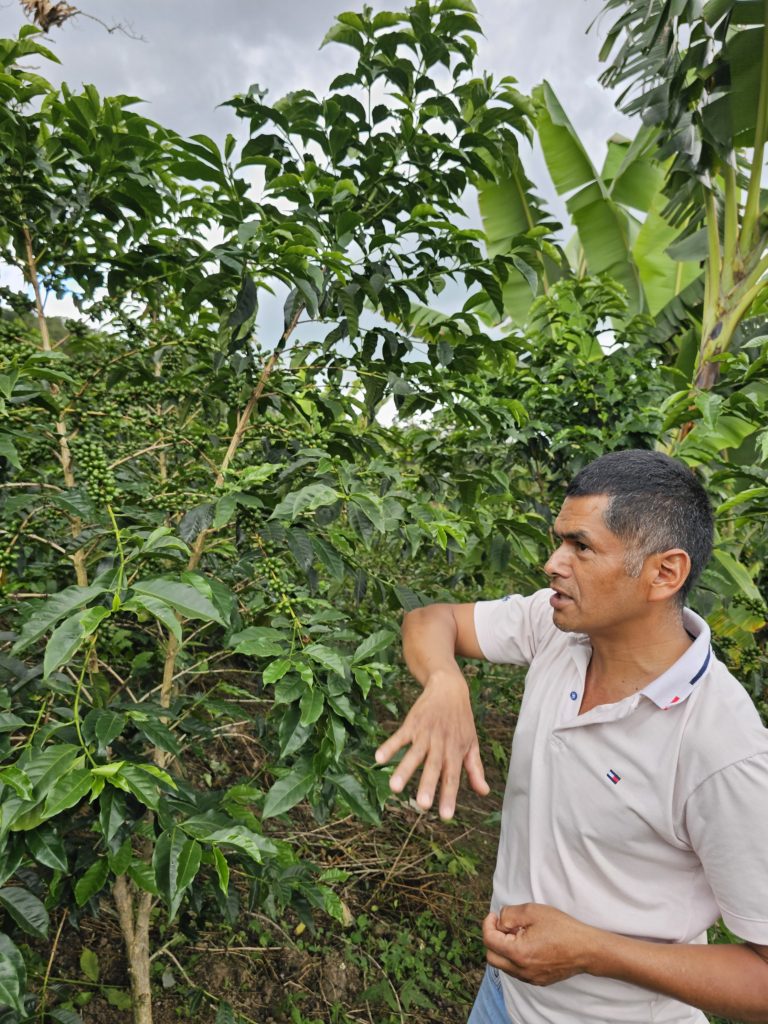
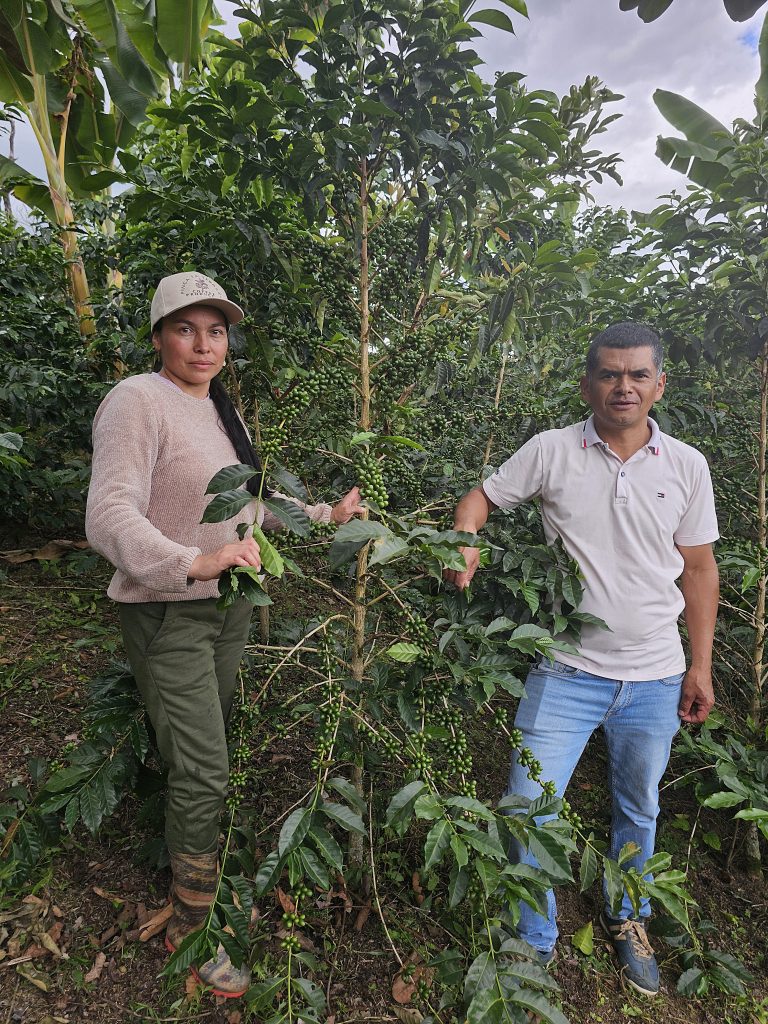
This is a moderately high intervention double fermented and washed Java variety coffee from Huila, Colombia, produced by 14 small family farms organized around Terra Coffee SAS and Mastercol Coffee.
The flavor profile is bright and buttery, clean, sweet, and complex. We taste the richness of dark chocolate accompanied by Cara Cara oranges, toffee, grapefruit, nectarine, and pink peppercorn.
Our roasters found it hard to do wrong by this coffee, but generally enjoyed slightly faster roasting styles.
When brewed, we favored coarsely ground and updosed pour-overs on multiple brew devices, while enjoying flexibility of extraction and flavor profile as espressos.
Taste
Taste Analysis by Chris Kornman
This lush and lively double-fermented Java is the companion lot to the more classically prepared offering we released last week, and they’re a complimentary pair, both reaching for the high notes. The addition of extra farmers to compile this volume, plus the multi-stage fermentation process, has added uniqueness and diversity to the cupping notes.
The coffee has an almost indescribable richness to it, something subtly different from “fullness” and inclusive but not exclusively complex. It’s medium-bodied but gives the impression of decadence, buttery in texture if not slightly browned in flavor and viscous, yet clean. It is undoubtedly a bright coffee, reliant but not dominated by citrus fruits like pink grapefruits and Cara Cara oranges (we tasted various jellies, jams, preserves, and marmalades). The Cara Cara is revealing as a flavor note – citrus forward but less acidic than its classic Navel cousin, sometimes described as almost berry-like in flavor. True to form, our tasters found hints of blackberry, cranberry, and tamarind, and sweetness like ripe peaches or nectarines.
You’d think, with all this body and acidity, there might be an unsubtlety to the coffee but rest assured it has a delicate side as well. I picked up the aroma of elderflower and chamomile, my colleagues noted breakfast-tea-like delicacy, pink peppercorn piquancy, and hints of hibiscus.
Highly recommended for those looking for a twist on a classic or a heightened experience of “more than washed,” “more than Colombia,” “more than enough” in all the best nuances of each of those phrases.
Source
Source Analysis by Charlie Habegger
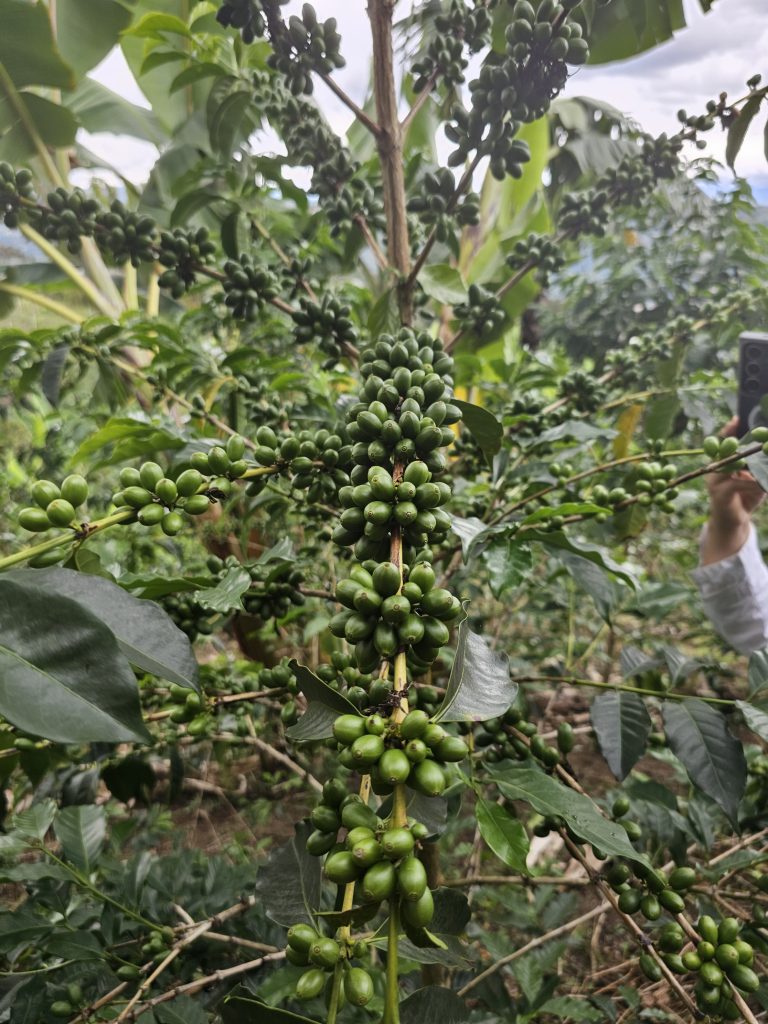
Multi-farm blends in Colombia are practically a necessity for exporters, given that the country’s 500,000 producers average only a single hectare or so. This microlot is a unique twist on the status quo, combining the pickings of one very rare cultivar grown on 14 different farms in the same small region, giving us a sizable representation of genetics and terroir.
Records indicate that the cultivar we know as Java was selected from a few mother trees in Ethiopia by the Dutch coffee researcher P.J.S. Cramer in 1928. Seeds from these trees were sent to Java, and the plants flourished and showed resistance to leaf rust where other Arabica varieties had faltered. To this day, in Indonesia the cultivar is referred to as Abyssinia (or as cognates Adsenia or Abissinie), the name of Ethiopia at the time. The trees look very similar to Typica, and were frequently attributed as such, but true Abyssinia-Java’s provenance is directly Ethiopian, from 20th century selections. It continued its journey from Indonesia to Cameroon and thereafter to Central America where it can still be found with some frequency.
Southern Huila
Huila is arguably Colombia’s best-known department for top microlots. Huila’s geographical accessibility, dense population of knowledgeable farmers, warm and subtropical forests, high elevations, and microclimate diversity have for many years sustained one of specialty coffee’s most beloved regions. The fact that most of the department is harvesting coffee almost every month of the year, means that fresh coffee is always available.
Huila is a long and narrow valley that follows a winding gap between two large cordilleras of the Andes. Uphill from the valley’s lush and picturesque lower slopes (Colombia’s 950-mile long Magdalena river has its source in southern Huila and has shaped the agriculture here for centuries) are a diverse array of coffee producing communities, often dramatically steep, and each with their own unique climate and history.
Palestina, Timaná, La Argentina, and Oparapa are all communities in the vicinity of Pitalito, located in the southern end of Huila’s central valley. They are rugged and densely tropical landscapes home to a large number of sharp, experienced, and ambitious coffee producers with options to sell their coffee to a number of competing buyers. When many roasters think of Huila, they think of this area.
The Farms & Processing
The 14 farms involved are coordinated by Mastercol Coffees, an exporter specialized in representing innovative producers and coffees. Farms range from 1.5 to 4 hectares in size, and the farmers have all been producing coffee for at least the past 20 years. Working with Mastercol, the growers feel they have the support they need to maximize the quality of their farms, as well as their income—creative microlots like this one are a great example of this, since any one farmer’s java would only amount to a few hundred pounds.
At each farm the java plants, like all others, are harvested manually and with the help of extended families. Once the ripe cherry is picked it is fermented in nylon bags for 36-48 hours to allow internal sugars to peak and the fruit flesh to soften. The belief with the additional cherry fermentation is that the sugars and liquids present in the coffee cherry combine and influence the seed prior to fruit removal, intensifying the overall sweetness and clarity of fruit notes in the final cup. After the cherry ferment, a traditional depulping is carried out, followed by a traditional open tank fermentation of the parchment that lasts between 50-80 hours depending on the climate. Once this is complete, the parchment is washed clean with fresh water and moved to sun-dry for 15-20 days.
Green
Green Analysis by Isabella Vitaliano
Moisture content is above average at 12.2%, and Rotronic reading is above average as well. Crown Jewel boxes come in Ecotact bags, which provides more than enough protection to ensure that it does not stale quickly, but it is something to keep an eye on if you live in a humid place, especially during the summer months.
Diedrich
Diedrich IR5 Analysis by Doris Garrido
This double fermented coffee from Colombia arrived with a high moisture content. For this particular roast, I intentionally slowed the drying phase, applying the majority of the heat during the middle of this stage and carefully controlling it as we entered yellowing.
My charge temperature for this 4.5 batch was 378F. I waited until after the turning point to begin adding the gas: 70% initially, increasing to 100% at 3:30/ 232F. Just before the color changed, I reduced the heat to 70% then 30% immediately after. At this point, I initiated 100% airflow. I smoothly transitioned into the first crack and allowed 1:35 minutes for development, dropping the temperature at precisely the right moment.
This roast ended with 5:26 minutes of drying, 3:08 on yellowing, and 1:35 minutes on post development. This is a straightforward roast profile with just a few significant roast adjustments.
I was very pleased with the results. This coffee presented a sweet and subtle botanical aroma. On the taste, we found notes of grapefruit, sweet nectarines, caramelized peach, rich chocolate and salty caramel.
Aillio
Aillio Bullet R1 IBTS Analysis by Chris Kornman
We use the RoasTime app and roast.world site to document our roasts on the Bullet. You can find our roast documentation below by searching on roast.world, or by clicking on the link below. Take a look at our roast profiles below, as they are constantly changing!
A delightfully zesty and full-flavored coffee with lots to uncover, I think you could probably roast this coffee any which way and still find something delicious to describe.
I opted to try for a slightly faster roast, charging with my standard hot temp (482F IBTS / 350F standard thermocouple) and P7 / F2 / D4 starting spec for this 500g batch. I kept the drum speed steady throughout the roast, dropped the power to P5 at the turning point and kept it there until first crack, but gradually increased the fan speed in small stepped movements throughout color change, resulting in a very balanced looking roast, with roughly equal time (3:40-ish) in drying and Maillard stages, and a precise 1:30 of development after first crack.
Very little out of the ordinary here, the coffee takes heat well, exactly as you’d expect a Colombian-grown Ethiopian cultivar to perform, the additional fermentation step has added a nice layer of complexity in the cup but relatively little in terms of complications in the roaster.
We tasted citrus jam, pink peppercorn, ripe peach, tamarind, chamomile, almond, cinnamon, and honey.
You can follow along with my roast here at roast.world: https://roast.world/ckornman.wnD2/roasts/g-Zdom7kKHdQq-wo8XUzb
IKAWA
Ikawa Pro V3 Analysis by Isabella Vitaliano
Our current Ikawa practice compares two sample roast profiles, originally designed for different densities of green coffee. The two roasts differ slightly in total length, charge temperature, and time spent between color change in first crack. You can learn more about the profiles here.
This coffee really can do no wrong. Excellent in both the high-density and low-density versions, let’s see which one the team preferred in a tight race. The low-density roast was tart, bold, and complex, but floral, with sweet, zesty notes. The high-density roast was light, with soft sweetness like flan and a buttery, creamy, pudding-like texture and flavor. Both roasts had a lovely florality to the aroma and fragrance of the cups.
I recommend trying the low-density roast first to see how this coffee pops. If you are curious about a more subtle take for your menu, try the high-density roast next.
You can roast your own by linking to our profiles in the Ikawa Pro app here:
- Roast 1: Low Density Sample Roast
- Roast 2: High Density Sample Roast
Brew
Brew Analysis by Katie Briggs
A fun coffee coming out of Huila Colombia, I was very excited to get some brews started! I started off on the Kalita Wave flatbed brewer, at a dose of 19, and a grind of 9.5. I did a 50g first pulse of water and let bloom for 40 seconds. I did the last two pulses of water, first bringing it up to 200g, and then to 300g. I liked this brew quite a bit, although the TDS was a little high and it tasted a bit heavy. The team still got some nice notes of orange, toffee, milk chocolate and nectarine.
I wanted to thin the coffee out a bit with the next brew, so I just did the same brew but at a coarser grind of 10. I did the same bloom and the same water pulses for this brew. I liked this brew a little bit more, but it was still a similar TDS and still had a bit of heaviness. I still wanted to get this down a bit, so the next brew I did a grind of 11 on the same Kalita Wave flatbed brewer.
I did the same brew method with these specs, and this was a great brew! It was a lot softer, and the team got notes of raspberry, toffee, black tea and short bread. I really liked this brew a lot, but I just wanted to do one more on the V60 cone brewer to see how this coffee would brew.
I did the same specs as the last brew for this one, but on the V60 obviously, and I also really liked this brew! It had a lot of the same sweetness of chocolate, and black tea, with a brighter acidity that can be compared to juicy oranges and raspberries. I think I liked this one a touch more, but these last two brews were both very good.
I would recommend a coarser grind, whether on a flatbed brewer or cone brewer, and a higher dose, which tasted really good throughout all of my brews of this coffee. Either way you will get a consistently good cup of coffee! Enjoy!
Espresso
Espresso Analysis by Marie de Courcy
I had a good time experimenting with this double washed and fermented Java coming from Huila, Colombia. Each recipe presented a lot of complexity and room to find worlds of flavor in each extraction. To find something bright, juicy, and citrus heavy, try a lower dose with a longer yield, and for something a bit more traditional, go on the heavier side in your dose with a shorter yield.
My first recipe used a dose of 19g, a 41g yield, and 27 second extraction time. While it was bright and punchy, plenty of delicate floral notes came through. I found notes of lemon candy, jasmine, and toffee on the finish.
My second recipe used a dose of 20g, a 38g yield and 27 second extraction time. Going heavy on the dose brought a lot more chocolatey depth forward, while maintaining that sweet citrus and reaching a more balanced shot. I found notes of Reese’s peanut butter cup, coffee ice cream, and cherry limeade.
This coffee is extremely versatile and can please anybody’s palate comfortably. Keep your dose moderate with a longer extraction for something on the brighter and juicier side, and go a bit heavier on the dose with a shorter extraction to push chocolatey richness forward.
Related Coffee
Hops, lime, botanical, floral, and pink grapefruit
Oakland 27 Boxes
Crown Jewel Colombia Carbonic Honey Cascade Hop Co-Fermented Pink Bourbon Edwin Noreña
37702-1 – SPOT RCWHSE
Hops, lime, botanical, floral, and pink grapefruit
Spot
27 Boxes
$376.84 per box

Green apple, jolly rancher, apple, mojito, apple cider
Oakland 21 Boxes
Crown Jewel Colombia Carbonic Honey Green Apple Co-Ferment Edwin Noreña
37710-1 – SPOT RCWHSE
Green apple, jolly rancher, apple, mojito, apple cider
Spot
21 Boxes
$434.39 per box
Peach, jasmine, peach black tea, grapefruit, and peach nectar
Oakland 49 Boxes
Crown Jewel Colombia Carbonic Honey Peach Co-Ferment Edwin Noreña
37701-1 – SPOT RCWHSE
Peach, jasmine, peach black tea, grapefruit, and peach nectar
Spot
49 Boxes
$376.84 per box
Caramel, grape, jasmine tea, biscoff cookies, and melon
Oakland 7 Boxes
Crown Jewel Yemen Anaerobic Natural Sharqi Haraz Cooperative
37919-1 – SPOT RCWHSE
Caramel, grape, jasmine tea, biscoff cookies, and melon
Spot
7 Boxes
$685.69 per box