
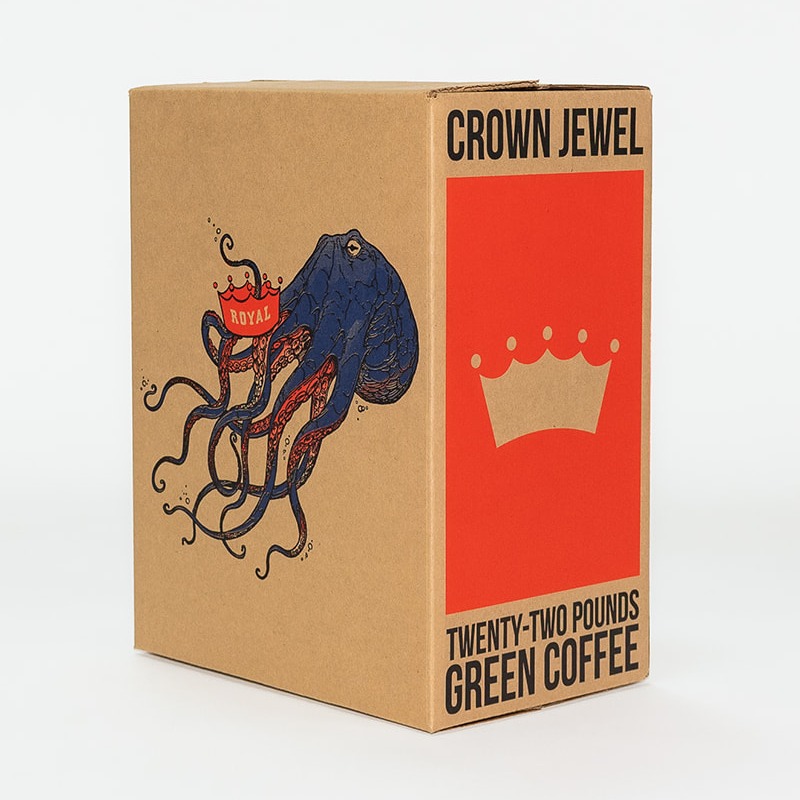
Crown Jewel Kenya Anaerobic Natural Ichamama Factory Othaya Town
22KE2020 – 36859-1 – SPOT RCWHSE
Boxes 0
Warehouses Oakland
Flavor Profile Orange, black tea, pomegranate, raspberry, and caramel
Out of stock

Overview
Overview
This is a low intervention anaerobic natural coffee from Nyeri, Kenya, produced by cooperative members of the Ichamama Factory and Othaya Cooperative Society.
The flavor profile is intense and uniquely complex, with the acidity of Valencia oranges, mango, and candied ginger, the warm spice of garam masala, the botanical depth of bay leaves, the defining Kenya-esque qualities of tomatillo, and the comforting sweetness of pistachio ice cream and crème brûlée.
Our roasters noted the quiet nature of first crack and felt the coffee didn’t need as much heat throughout roasting as compared to other Kenyan offerings.
When barista team found something for everyone in nearly every brew, noting versatility and general deliciousness across a number of specs. Their favorite dials started with moderate doses and medium grind settings; no need to try anything fancy for this coffee to shine.
Taste
Taste Analysis by Isabella Vitaliano
A special debut, this is the first ever Kenya natural coffee on the Crown Jewel menu. Although the CJ program has been active since six years ago, it has taken a special coffee to fill these criteria. It has not been a lack of offers that has prevented us from selling this coffee but rather, a lack of quality. Kenyan naturals do not often have a seamless integration of savoriness from origin coupled with the fruity flavors from the processing method.
,The coffee creates a succinct melody between the two with attributes with flavors pistachio ice cream, lime leaf, cucumber, botanicals, bay leaf and pomegranate. An almost roundabout experience that starts with notes of Valencia orange, graham masala and takes a 180 to aromatic cedars, ginger and then back around again to allspice and ginger.
This coffee makes up for the lack of previous offerings hitting the mark. This is the pinnacle union of both processing and origin. It was interesting to roast it on ikawa, a surprising sentiment, because the flavors really edged between that fruity and savory combination to a more classic kenya profile. Both delicious in their own right but I think if you have the time and energy to really explore profiling with this coffee, anyone could find a profile that they like.
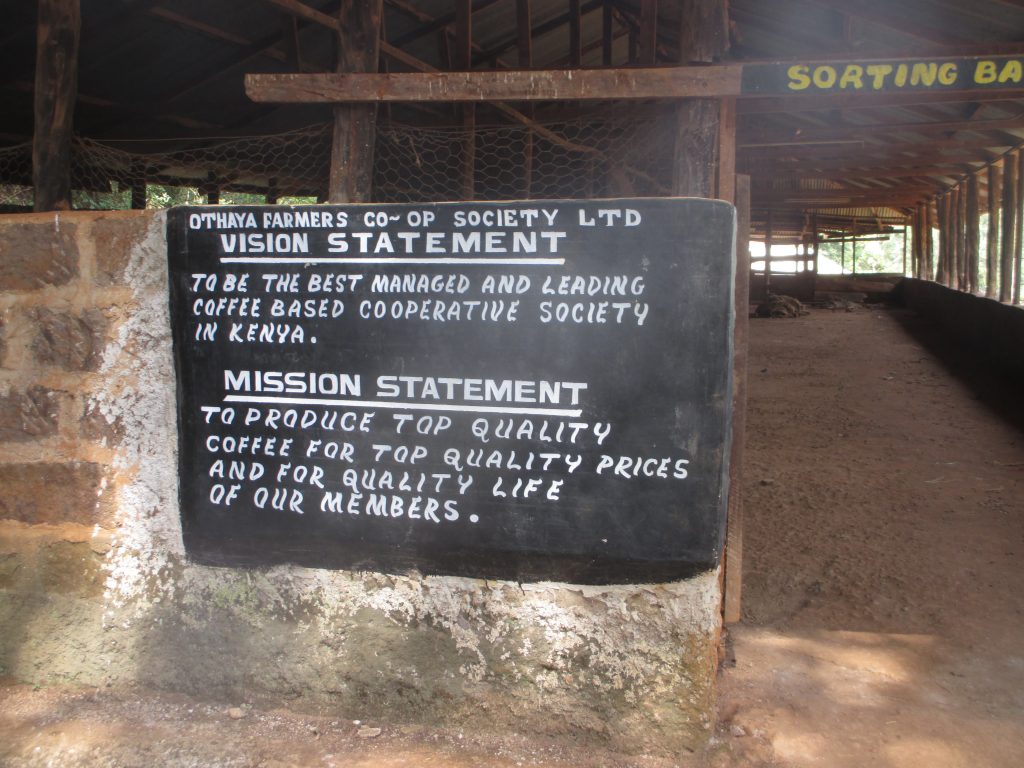
Ichamama is the washings station this was sourced from the group, Othaya Farmers Cooperative Society. Formed in 2009, the group have had 17 years to sharpen their processes and offer some of the best coffees we see from Kenya. Washed coffees from the region are plentiful due to the easy access to water. Natural coffees from the coffee are more difficult to find and even at Ichamama it takes up a much smaller part of the operation.
Successors to this coffee will have a lot to live up to. Cheers to this Crown Jewel exclusive. We know you will enjoy this one.
source
Source Analysis by Charlie Habegger
Ichamama is regularly one of the best, most straightforward Kenyas we buy. When they started offering naturals in addition to the standard washed lots we bought for years, we were thrilled. This year’s natural selection is big, jammy, and berry-like, unmistakably a natural, with heavy chocolate and sweet wine, but also a decent amount of brightness as well for an intense but balanced cup.
Welcome to Nyeri
Mt. Kenya, at the helm of Kenya’s Central Province, is the second tallest peak on the continent of Africa and a commanding natural presence. The mountain itself is a single point inside a vast and surreal thicket of ascending national forest and active game protection communities.
The central counties of Kenya extend from the center of the national park, like six irregular pie slices, with their points meeting at the peak of the mountain. It is along the lower edge of these forests where, in wet, high elevation communities with mineral-rich soil (Mt. Kenya is a stratovolcano) many believe the best coffees in Kenya are produced.
Nyeri is perhaps the most well-known of these central counties. Kenya’s coffee is dominated by a cooperative system of production, whose members vote on representation, marketing and milling contracts for their coffee, as well as profit allocation.
Ichamama Factory & Processing
Ichamama factory membership is primarily 1-acre farmers, less than half a single hectare. Coffee is a most critical cash crop among them but is not the only thing grown—farmers tend to have legumes and vegetables, and occasionally livestock or tea as well. Farmers deliver cherry weekly or more during the harvest month, handpicking and transporting everything themselves or with the help of small amounts of local labor.
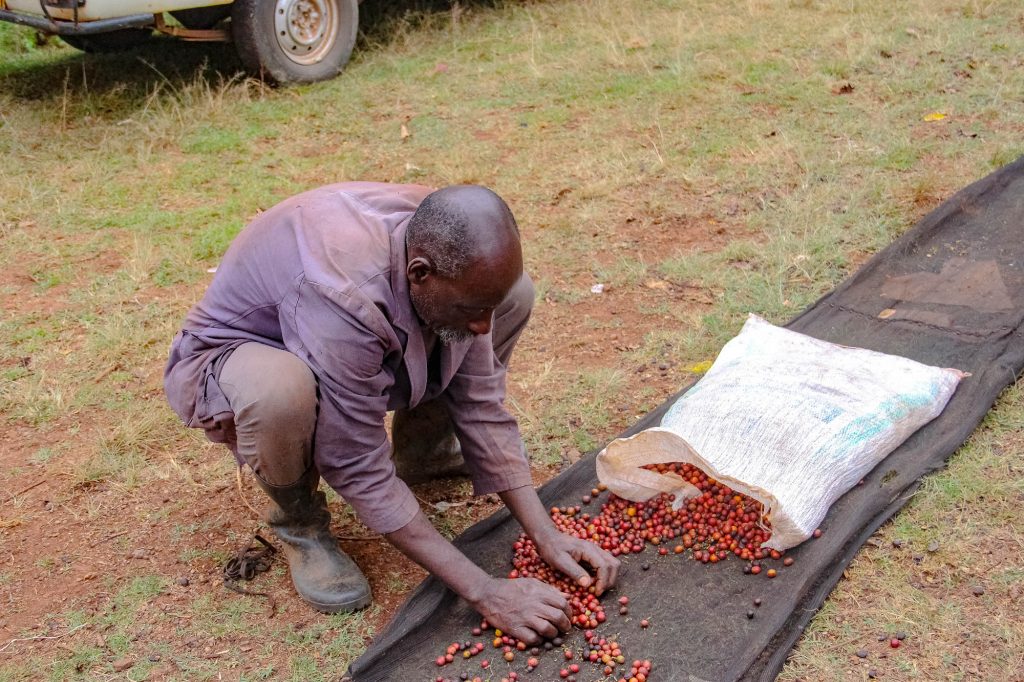
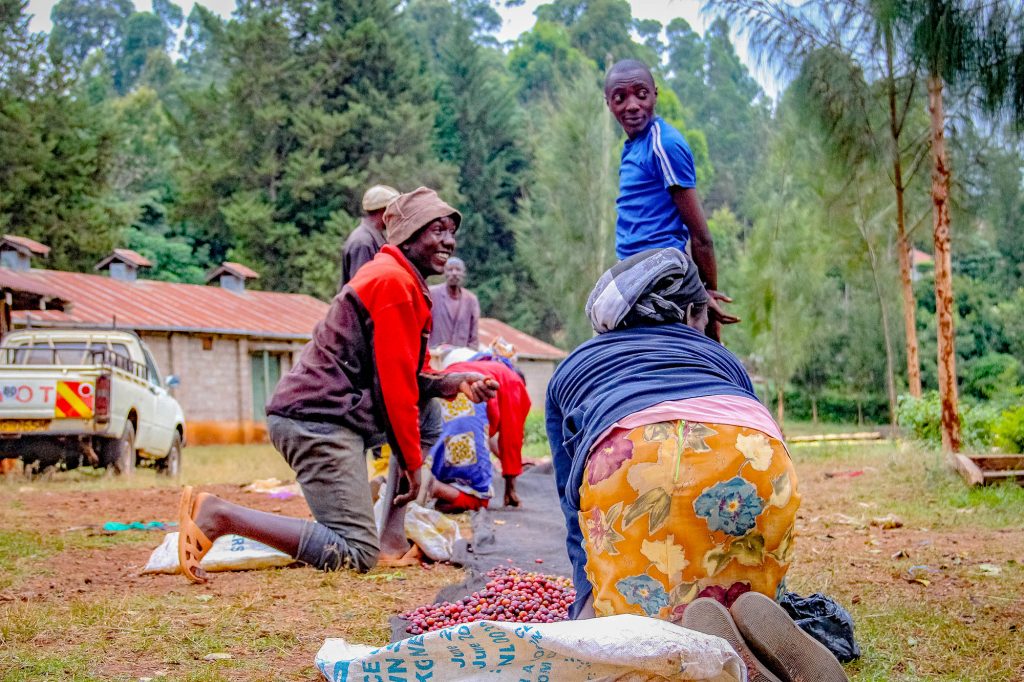
Naturals at Ichamama are a much smaller operation than standard washed coffee, as to be expected in Kenya, where fully washed is by far the norm. Hand-sorted cherry is weighed and logged under the contributing farmer’s name, and then moved directly to raised beds where they are initially wrapped in polyethylene plastic and allowed to ferment anaerobically for 48 hours. After this phase the cherries are left to sun-dry for as long as 29 days, far longer than standard washed parchment, until the internal moisture is 10-12%, during which they’re rotated constantly to ensure even airflow.
Othaya Farmers Cooperative Society
Othaya Farmers Cooperative Society, the umbrella organization that includes Ichamama, is one of Kenya’s larger societies, with 19 different factories and more than 14,000 farmer members across the southern Nyeri region. Othaya is a part of the Kenya Cooperative Coffee Exporter. KCCE is an historic organization comprised of many individual coop societies. The group was formed in 2009, with the express goal of managing marketing and exporting operations cooperatively, as opposed to contractually with third parties. In addition to coffee production, KCCE oversees a cooperative network of millers and a domestic roasted coffee brand sold nation-wide in Kenya.
The economics of smallholder systems are consistently difficult everywhere in the world, and in Kenya in particular the number of individual margins sliced off an export price before payment reaches the actual farms is many, leaving only a small percentage to support coffee growth itself. And most often this arrives many months after harvest. KCCE, by managing more of the value chain itself, can capture a greater margin on behalf of the farms.
Green
Green Analysis by Isabella Vitaliano
Density is on the below-average end with water activity roughly average. Screen size is a little bit spread out; just be sure to watch out for uneven roasting. Specs indicate good prep with attention to detail by the Ichamama factory and Othaya Farmers Cooperative Society.
SL28 is a well-known cultivar in Africa and has a very good reputation for cup quality and resistance to drought. It does not fare well against major diseases in coffee but for the most part is durable and notable for its rusticity. The plant can be left alone for a few years but return to successful production levels. Scott Agricultural Laboratories initially selected the cultivars and was a Laboratory that was established by the British government in Kenya in 1920’s.
SL14 was produced in the late 1930’s by Scott Labs and was selected from a single tree labeled Drought Resistant II. Genetic tests have confirmed that it is related to the Typica genetic group and it is important to both Kenya and Uganda.
Ruiru 11 is a bit of a Frankenstein coffee with many progenitors to its genetics including K7, Timor Hybrid, Sudan Rume, N39, Sl28, SL34 and Bourbon. It was created in response to the coffee berry disease epidemic in 1968 and took 20 years to develop and release into the coffee sector of Kenya. This coffee was chosen because of its compactness and resistance to disease. Once finally released and cultivated, green buyers had a bad response to it due to its cup profile. Although specialty green buyers don’t love this crop, many farmers love it because of its resilience. It is difficult for the station in Kenya to produce adequate volumes of seed to meet the demand by farmers. Ruiru 11 relies on hand pollination for mass propagation, a slow and tedious process that limits production.
Diedrich
Diedrich Roast Analysis by Chris Kornman
Natural Kenyan coffees have always been a bit of a rarity. I’ve tasted a handful, but never profiled a roast for one before, so I started feeling a little like I might be a bit out of my depth as I stepped up to the roaster in Doris’ absence this week.
Turns out, there was nothing to worry about. This coffee was a breeze, and it treated me nicely even though I was a little nervous at first.
So, there’s a good bit of conflicting information to take in as a roaster for this coffee. The green is moderately dense and fairly dry, with a wider than expected range of screen sizes. It’s a somewhat high-elevation Kenya, but it’s also an anerobic natural… so… how do we interpret all of this?
My take was mostly to shoot for the middle and hope the coffee would tell me what it needed as we went through the roast together. Early sample roasts offered a glimpse into the potential acidity this coffee could showcase, but high acid roasting styles aren’t necessarily the right choice for big fruity-sweet dry processed coffees. When I look at a sample roast, and see potential, my two questions as a production roaster are (a) “what are this coffee’s strengths?” and (b) “how can I showcase them best?”
Without feeling like I needed to invite any further acidity, I could rule out the usual hot/fast approach for dense Kenyas. But I also didn’t want to wash it away entirely with a slow, gentle approach I might use for the more-process forward types of coffees. So I decided to start with a pedestrian charge temperature (425F on the bean probe), a 1-minute soak, and a standard airflow progression (start low, 50/50 around color change, and open fully at first crack). No fancy stuff, no unexpected twists and turns, and most importantly, no ego.
Just before the turning point, I opened the gas to 70% power to see how the coffee would react. With color change imminent, I opened the airflow a little earlier than usual as the exhaust temperature continued to rise. I wanted to be careful not to rush the Maillard reactions. At 5 minutes, we were into color change and things seemed to be going smoothly. I dropped the gas quickly to 30%, our minimum setting on the Diedrich, watched a little blip on the ROR fade (possibly, this was my fault for over-tryer-ing). As first crack approached, my ROR was little higher than my target of 15F/60s so I opened the airflow fully. I marked a quiet but audible first crack at 8 minutes and 382F with my ROR at 14 and dropping slowly and predictably. The exhaust temperature was steadily descending and my ROR dipped in tandem as the coffee took on color.
Things were going well! I kept my eye on the color and took a deep breath, letting the coffee develop a few seconds past my usual drop time after crack. I opened the door and dropped the batch at 9:38 total roasting time and a 398.5F end temperature to an exterior ColorTrack of 63.56 and ground reading at 55.16, on the light side without being light light. I wanted to make sure she was sweet and not too sharp.
I wasn’t sure how it’d turn out, to be honest. Sometimes the middle of the road is just a recipe for mediocrity. But in this case, some combination of luck, instincts, and experience favored my choices. At the cupping table, Josh told me that I’d “restored his faith” in this coffee. It felt good, like an old dog learning a new trick; like riding a bike after a long break.
We tasted unique botanicals like bay and lime leaves, we noted fruits from pomegranate to horned melon and papaya, we spoke of orange bitters, cucumber, and pistachio ice cream. It’s a wild ride, an unusual coffee, a once-in-a-summer-coffee.
aillio
Aillio Bullet R1 IBTS Analysis by Evan Gilman
We use the RoasTime app and roast.world site to document our roasts on the Bullet. You can find our roast documentation below by searching on roast.world, or by clicking on the link below. Take a look at our roast profiles below, as they are constantly changing!
Knowing one Kenyan coffee is not knowing all Kenyan coffees. Just a few years ago, a Kenya natural would be a true rarity, and now we’re seeing more offers of fantastic fruit dried coffees from this country. What’s consistent with our prior experience is the consistent quality and the incredible depth of flavor. The long drying time contributes to this depth, and I’m enamored. We’ve worked with Ichamama coffees for many years, and to my knowledge, this may be the first time we’re getting a natural from them.
I did want to hit this coffee with plenty of heat because, well… it’s Kenya. I started at 464F, P8 power, and F2 fan as is my wont these days, and increased airflow to F3 just a little after turning point, following up with P7 power to begin the path to crack. At 4:00 / 342F I added more airflow to F4, then at 5:15 / 363F reduced heat to P6. Finally, I added airflow to F5 just before first crack, and reduced power to P5 just after. This coffee didn’t need much push once it got going, likely due to the lower moisture content, though its screen size wasn’t as consistent as a typical Kenya.
What I found was that crack was quite soft on this coffee, so that’s something to watch out for. I took this coffee to 8:15 / 397F before dropping, and while that’s not such a high end temperature, I did achieve very good coloring on this roast. The aroma coming right out of the roaster was fantastic.
This carried through right into the cup; I could smell this coffee brewing all the way across the apartment. Super rich chocolate, sugary date flavors, and a finish like Turkish delight made this coffee an absolute treat. As it cooled, I got more berries and a touch of something like grape soda mixed with jamaica hibiscus drink. Stick around for the cold cup and you’ll get some intriguing magnolia-like (think Magnolia champaca) florals. I’m on my third cup, and there’s no sign of stopping.
You can follow along with my roast here at roast.world: https://roast.world/egilman/roasts/JnU-ToQ_HaHj_8iPkZf4Z
IKAWA
Ikawa Pro V3 Analysis by Isabella Vitaliano
Our current Ikawa practice compares two sample roast profiles, originally designed for different densities of green coffee. The two roasts differ slightly in total length, charge temperature, and time spent between color change in first crack. You can learn more about the profiles here.
Our first Kenyan natural, I was surprised to find that both of these roasts were both so delicious on the Ikawa. The high density roast was more fruit forward with elements of dark fruit, candied ginger, orange chocolate and cranberry. Extremely balanced but still interesting, I really enjoyed this roast. The light density roast was a bit more savory with green apple, tomato paste and jolly rancher. The acidity felt a little bit less cohesive but some might find this roast a little bit more exciting. While Doris and I preferred the high density roast Chris preferred the low density roast.
You can roast your own by linking to our profiles in the Ikawa Pro app here:
- Roast 1: Low Density Sample Roast
- Roast 2: High Density Sample Roast
Brew
Brew Analysis by MJ Smith
As soon as I saw the words “anaerobic” and “natural” on a Kenyan coffee, I knew that I was in for a fun (and wild) ride. Ichamama has become an annual staple here at The Crown, but I don’t think I’d ever had anaerobic natural from them, so I was very excited to be the one to write this analysis. This is another one of those coffees where every brew had something to love about it. There really was something for everyone in every cup. From caramelly sweetness to stone fruit and citrus, to florals and spice and seemingly everything in between… Let’s get into these brews, shall we??
The first brew I want to write about was made on the Kalita Wave and had a ratio of 16.67. It had a dose of 18g, a grind of 10, and a final brew time of 3:30. Personally, I thought it tasted like caramel apple cider, ginger, clementine, jasmine, brown butter, and just a hint of sweet caramelized onion. I shared some with the rest of the team and they found some additional notes of black tea with lemon, nectarine, and orange zest. All in all, a bright and tasty brew!
Next up, I switched over to the V60 to see how that would change the brew. I also increased the dose to 19g, giving us a ratio of 15.79, and a final brew time or 3:45. To me, this one also had some really nice caramel apple notes, but this time, it reminded me more of those caramel apple lollipops that come in the bright green wrapper, to be hyper-specific… I also found notes of sweet potato fries, nectarine, Meyer lemon, pomegranate, jasmine, and cinnamon sugar donuts. Literally everyone in the building tried this brew so I had a lot of additional notes to go through, but here are the highlights: key lime pie, cardamom bun, pear, lemon verbena, hibiscus, raspberry, and tomatillo.
As you can see, there really is something for everyone in this coffee. Whether you like caramelly-sweet, bright and tangy, or any combination of floral, spicy, and slightly savory, this is the coffee for you! I suggest a medium dose and medium grind, but the rest I leave to you. It really is such a fun and delicious coffee to experiment with. Enjoy!
Espresso
Espresso Analysis by Asha Wells
As a barista at The Crown, we have no shortage of opportunities to work with interesting coffees, even so, I was very excited to analyze this unmistakable Kenya. Such a pleasure getting acquainted with a natural Ichamama, from her efflorescent floral peaks to her stunningly deep juicy valleys.
For my first recipe, I started with a moderate dose of 18.5g and a yield of 38g, clocking in at 33 seconds. This shot was really delicious, florals and citrus gone wild, with faint essence of pastries, that came through in scent but not palate. Imagine, if you will, a pomelo dripping with rose petal syrup, while a rhubarb pie cools in the windowsill.
Now for my next trick, with a coarser grind, a shot weighing in at a hefty 20g, yielding 42, and taking its time at 35 seconds. This baby was so bright and punchy, really delivering on the fruit details present in this coffee. Like hot lemons and strawberry grenadine, this shot carried with it a warming heat, and energizing juiciness. Sticking the landing with a remarkable, lush crema, that wrapped the palate like a bow.
Related Coffee

Orange, lemon, cranberry, vanilla, pear
Oakland 45 Boxes
Crown Jewel Rwanda Washed Jarama Kivubelt Estate
Lot 50 – 37912-1 – SPOT RCWHSE
Orange, lemon, cranberry, vanilla, pear
Spot
45 Boxes
$189.33 per box
Hops, lime, botanical, floral, and pink grapefruit
Oakland 27 Boxes
Crown Jewel Colombia Carbonic Honey Cascade Hop Co-Fermented Pink Bourbon Edwin Noreña
37702-1 – SPOT RCWHSE
Hops, lime, botanical, floral, and pink grapefruit
Spot
27 Boxes
$376.84 per box
Caramel, grape, jasmine tea, biscoff cookies, and melon
Oakland 7 Boxes
Crown Jewel Yemen Anaerobic Natural Sharqi Haraz Cooperative
37919-1 – SPOT RCWHSE
Caramel, grape, jasmine tea, biscoff cookies, and melon
Spot
7 Boxes
$685.69 per box

Green apple, jolly rancher, apple, mojito, apple cider
Oakland 21 Boxes
Crown Jewel Colombia Carbonic Honey Green Apple Co-Ferment Edwin Noreña
37710-1 – SPOT RCWHSE
Green apple, jolly rancher, apple, mojito, apple cider
Spot
21 Boxes
$434.39 per box