
Crown Jewel Tanzania Washed Gesha Neel & Kavita Vohora Karatu District
36527-1 – SPOT RCWHSE
Boxes 0
Warehouses Oakland
Flavor Profile Peach, orange, jasmine, floral, and grape
Out of stock


Overview
Overview
This is a fermented and washed Gesha variety coffee from Karatu, Tanzania, produced by siblings Neel and Kavita Vohora on their Gaia Farm.
The flavor profile is elegant and a little bit mysterious, with sublime sweetness and the expected notes of bright orange, ripe peach, and jasmine alongside pistachio ice cream and apricot jam.
Our roasters preferred gentler approaches with lower charge temperatures and low end temperatures.
When brewed, we liked the clarity and depth of an updosed V60 with a long extraction time.
Taste
Taste Analysis by Isabella Vitaliano
To get our hands on Gesha alone is such a treat but it continues to get better when we have the option to showcase this cultivar in two different processing methods. In this round of releases from the Vohora family not only do we see an exemplary display and range of cultivars but also how honed in their processing style is by offering both washed and natural coffees. The sister-brother duo I am sure have worked out so many fights in their youth that by the time they started working on the farm together, they make an unbeatable team, and you can see this in the cup.
Soft and subdued this coffee is as elegant as it a little but mysterious. As it’s hot you get the sort of classic floral notes but once it cools, you’ll find how expressive it is with flavors like lilac, jasmine and honeysuckle. This cup toggles between floral notes and sublime sweetness with flavors like almond pistachio ice cream, apricot jam and oranges. If you are looking to elevate your coffee menu and educate customers on what makes a good coffee, great. I think this is a really excellent way to introduce people to really high grade specialty coffee.
Often consumers confuse loudness in a coffee with high quality. In my experience, I think the reason is because when people are able to point out flavor notes easily they get really excited that their palate has clicked into place. I also had this sort of misconception about coffee quality when I first got into the industry. It takes awhile for people and especially consumers to see the value and quality of coffee when it is delicately floral, tea like and not overpowering in many ways. And really the only reason why it takes a long time for consumers to understand this is because there aren’t that many people serving this type of coffee.
This elegant take on a washed Gesha from the Vohora family will softly enter the hearts of the masses with its quiet strength, sweet tones and interesting florals.
Source
Source Analysis by Chris Kornman
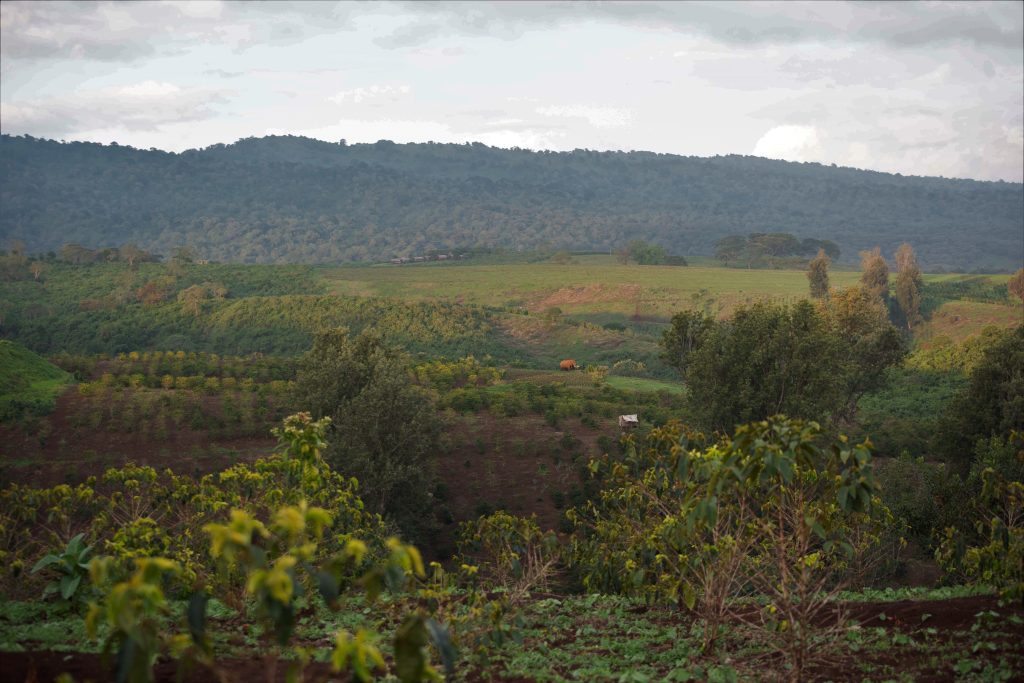
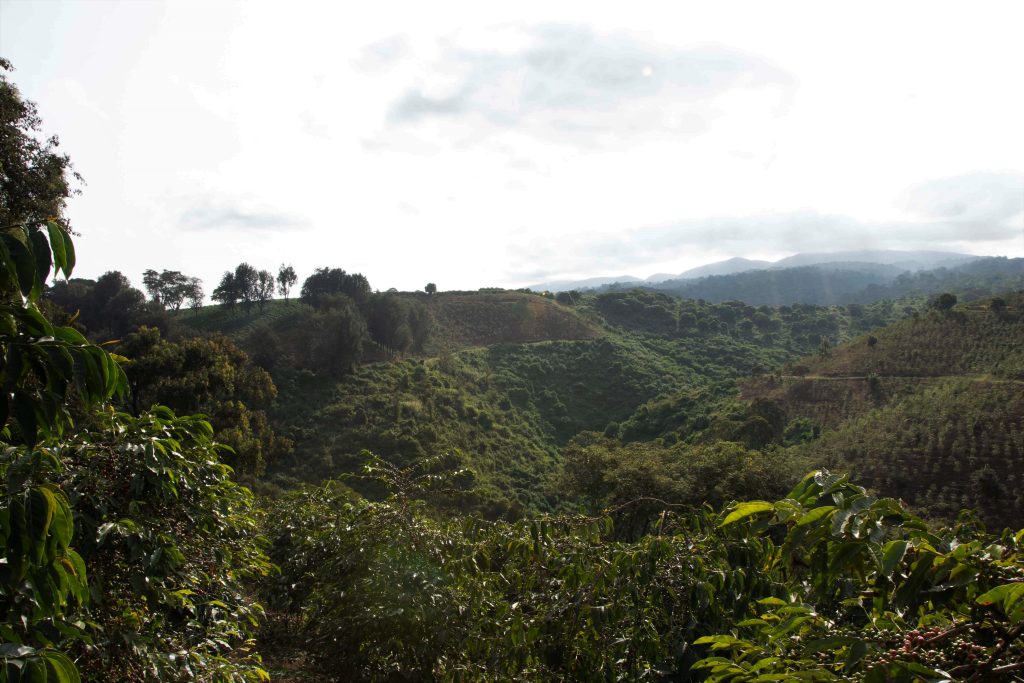
Under the watchful guidance of sibling team Neel and Kavita Vohora, the Edelweiss and Gaia farms have begun to blossom from well-managed estate farms, spanning 1000 acres across multiple ridges of the Ngorongoro caldera in northern Tanzania, into an innovative and genre-defying coffee enterprise. I’ve worked with Neel and Kavita, and the coffees from the farms for 15 years and I can definitively say that their most recent harvest is the most exciting I’ve ever tasted.
At the vanguard of the team’s efforts are their Gesha plantings, newly matured trees giving some of the first exportable harvests this year and stunning us with their deeply floral flavors and elegant nuance. The plants were grown from seed stock related to the New World’s initial Gesha trees, first noticed on the Peterson farm Hacienda la Esmeralda in Panama in the early aughts but brought to Costa Rica’s CIRAD facility as early as the 1960s from a research station in… wait for it… Tanzania. Neel’s befriended that research station’s current manager and has a vast trove of genetic information and historical records at his fingertips, and the data is fascinating. Needless to say, we’ll be keeping a close eye on some of the new seedlings I saw growing in the nursery at the farms on a recent visit.
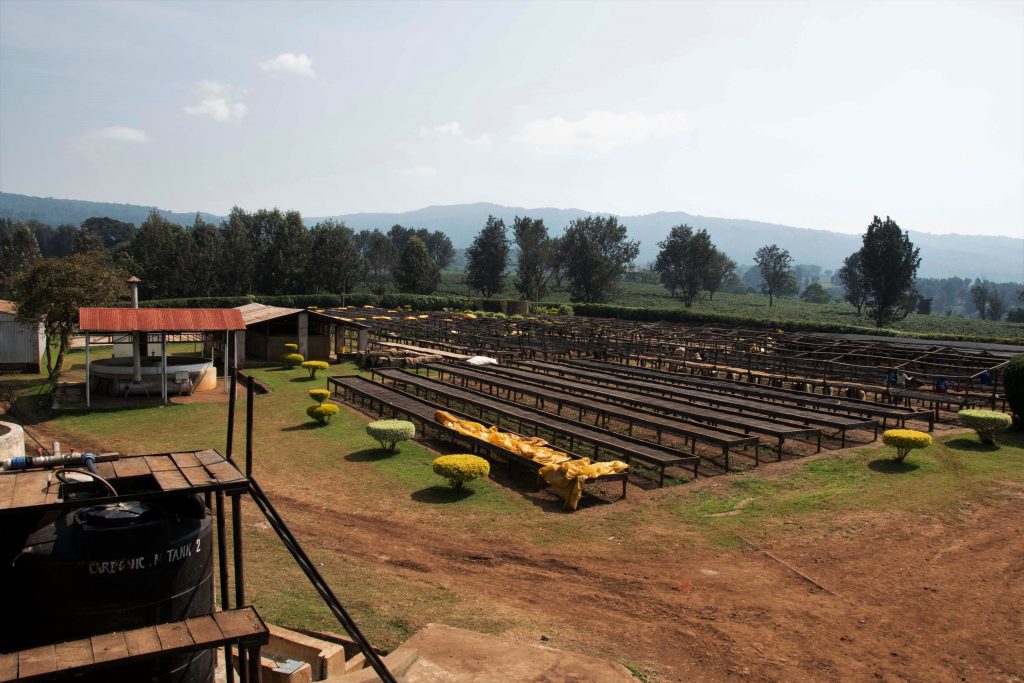
The Vohoras’ farms continue to innovate in processing methodology as well. Rather than resting on the laurels of tradition, nearly all of their coffee (including the commercial volumes of larger lots) goes through a cherry maceration period prior to processing. For microlots like this Gesha, the timeframe for whole cherry “pre-fermentation” is determined specifically by cultivar, through a trial-and-error process that’s been honed into precise protocols to bring out the best in each variety. In this case, the Gesha harvest will macerate in whole cherry on raised beds under protective tarps for four days prior to depulping and fermenting for 36-58 hours in a covered tank. After this, the coffee is washed, graded, and dried on raised beds for about two weeks. After this is finished, the dried coffee is stored in GrainPro until it can be milled in Vohora’s facility back in Arusha.
Ngorongoro, the world’s largest unbroken caldera, looms over a verdant landscape, the shell of an ancient, ruptured volcano. Inside its walls, a wildlife conservation area cut off from much access to the outside world, is home to hordes of zebra, eland, gazelles, wildebeests, two prides of lions, hyenas, hippopotami, and scores of other local birds and mammals, including a small population of black rhino. The Maasai, among the region’s more visible residents with distinctive red flannel robes and unchanged traditions of nomadism, are frequent visitors, passing through the crater with their goat and cattle herds in tow. The caldera’s wildlife are no strangers to the farms, either. Native forest corridors on the estates allow freedom of movement for the animals as they migrate, but it’s fairly common to find damage to the coffee trees; the most frequent offenders being elephants and water buffalo.
The Vohora’s estates are nestled into the caldera’s outer ridges, bordering the park. Since 1971, the Vohoras have owned about 1000 acres of farmland on the southern exterior slopes near the town of Karatu. The siblings’ grandfather arrived from India, first working for the British colonists as a farm manager prior to the nation’s independence, and their father founded and ran the export business from nearby Nairobi.
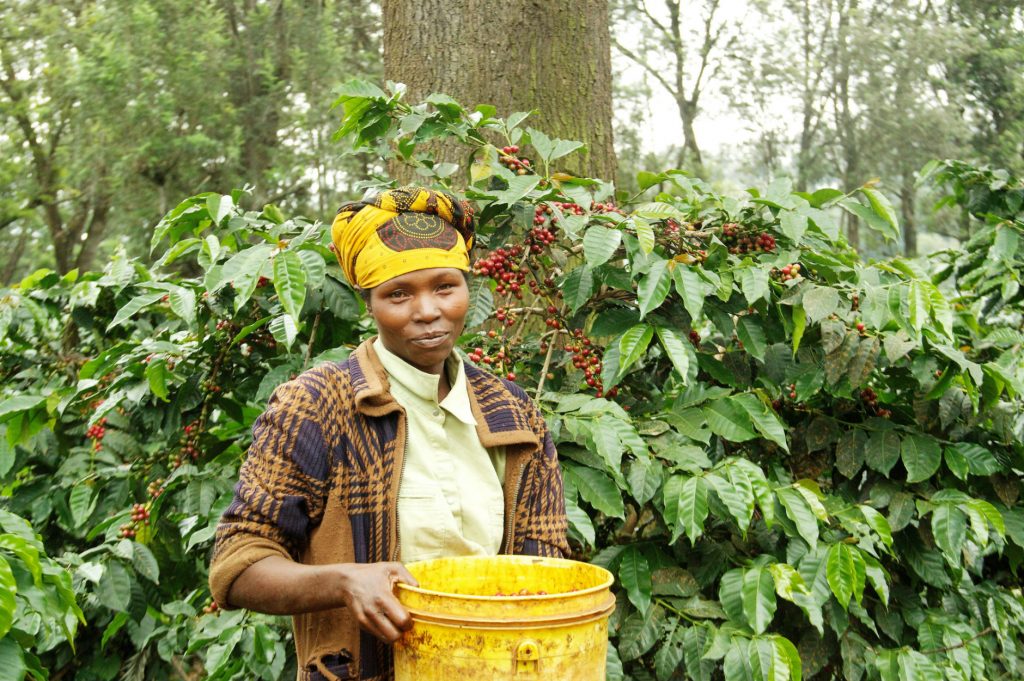
Today, Neel manages the farms, including overseeing more than fifty full-time employees and nearly eight hundred seasonal workers during the peak of harvest. He’s also at the forefront of processing innovations and cultivar selections. Kavita helms the export business from Arusha, and is the lead cupper and licensed Q Grader at the dry mill. Her daughter, Nicolene, is learning to taste coffee… the family’s fourth generation, now in training.
You can read more about the farms in a recent blog.
Green
Green Analysis by Isabella Vitaliano
The physical shape of the green is elongated and as a result the screen size is on the slightly larger with screen size in the 16-18 range. You’ll find some secondary defects here and there throughout the green but we have found this does not impact the flavor in any way.
Density is below average and the moisture content sits in a little bit below average range. This is the second processing style with this cultivar from the Vahora brother-sister duo. These specs are just about what we expect from this farm, and the cup quality gets better year after year!
Diedrich
Diedrich IR5 Analysis by Doris Garrido
This year, Tanzania’s Geshas are really rocking, this is our second from the Vahora family, a delicate washed Gesha. When I first cupped this harvest, it was my favorite from the arrival table, a beautiful coffee that showcased its florals more than ever. This coffee is making my work on the roaster much easier during profiling, especially when looking for those delicate aromas.
With the Diedrich, I aimed to warm the drum to 400F. This is a relatively medium-to-low starting temperature, but it allowed me to use gas from the beginning and utilize 90% of the roaster heat energy during the drying phase without damaging the beans. These beans have a medium density, and as they’re Geshas; I want to treat them gently. I started with 70% gas, and after passing the turning point, I took it to 90%. This phase lasted 4 minutes and 25 seconds. After this, I cut the gas to its lowest setting. Because of the Diedrich excellent heat retention, that was it for gas adjustments.
The final cup of this roast was pleasantly clean, allowing the coffee’s true nature to shine through with subtle orange blossoms and balanced rich flavors of pistachio ice cream, honeycomb, orange, bright lime and a little tart grapefruit. Without a doubt this is a beautiful work on the production of this coffee that ended in a juicy, floral and tasty cup. The Vohora siblings have delivered an incredible harvest again this year.
IKAWA
Ikawa Pro V3 Analysis by Isabella Vitaliano
Our current Ikawa practice compares two sample roast profiles, originally designed for different densities of green coffee. The two roasts differ slightly in total length, charge temperature, and time spent between color change in first crack. You can learn more about the profiles here.
This washed Tanzania Gesha is not one too miss out on, because the Gesha cultivar is typically a larger bean with lower density, I would expect that this coffee tastes better as a low density roast.
On the high density roast this coffee when it was hot was explicitly floral and bright with lots of jasmine tones. On the low density roast of this coffee, when it was hot the cup felt a little bit subdued but once it cooled it git so much better with lots of lemon curd, melon, raspberry and orange blossom.
Both coffees were delicious but because the low density coffee got exponentially better as it cooled down with soft florals and round body, I recommend trying out the low density roast of this coffee. Cheers!
You can roast your own by linking to our profiles in the Ikawa Pro app here:
- Roast 1: Low Density Sample Roast
- Roast 2: High Density Sample Roast
Brew
Brew Analysis by Isabella Vitaliano & Katie Briggs
There is so much to explore in this delicious coffee from Tanzania. Katie mostly mossed around with the V60 during this brew analysis and started off with a standard 18g dose and 300g out. The team found flavors like orange blossom, kettle corn, nectarine, basil and peppercorn. This brew was good but were curious about how a higher dose to amp up those flavors a little bit.
On the second brew Katie went with a 19g dose and the same output, 300g of water. The total brew time was a little bit longer, closer to 5 minutes. The group tasted flavors like butter milk chocolate, peaches, sesame, milk chocolate and jasmine. As it cools this coffee got even better with a slightly heavier body we found more chocolate notes while keeping those sweet floral flavors.
Katie also messed around with a flat bottom brew, a Kalita Wave, but found that it felt too heavy and was not as good as the other brews she was playing around with. Stick to the brewers that bring out more clarity like the V60.
Espresso
Espresso Analysis by Isabella Vitaliano
This washed Gesha, a seamless blend of East African terroir, processing and cultivar type. It offers subtle complexity and unmistakable quality in the cup.
In the first shot I started out at a higher does at around 19g in and 28g out with a 25 second shot. This shot was very citrusy with almond paste, cherry tart, berries and oh did I say citrus? A blend of lemon, lime and blood orange the team loved how tangy and sharp it was. I played around with a higher dose at 20g and then went back down to a 17gram dose.
This shot was really good in that it expressed more floral tones of the coffee but I was curious how something in the middle ground would taste. I went for an 18g shot 36 out at a 27 sec shot and this was the sweet spot for the coffee if you are looking to get a lot of the florals notes out. Jasmine icing, vanilla custard, lemon cake, candid papaya and chamomile. Sort of a pristine dessert line up in this shot! There were also some notes of cascara orange and rose petal jelly.
Chris likened the second shot to a “crown style shot” with the shot expressing the most out of the floral notes inherent to the coffee. He also compared the first recipe to an “intelly (intellegenica) style shot” from a barista gone rouge dialing in the single origin espresso. I immediately saw what he meant by that, the first time single origin espresso was entering into the specialty industry, the way to make an single origin espresso stand out was to make it really punchy an in your face. I also had a similar experience working at my first coffee shop in Florida. While this shot is a very expressive it does have less noticeable florals compared to the second shot. Maybe it’s the nostalgia but I do really enjoy this shot.
You can’t really go wrong with this coffee and I would argue it’s pretty hard to mess up as espresso. Putting a Gesha on is pretty much a guaranteed showstopper and even if it’s for a weekend, I would highly recommend serving it as such. Baristas will love dialing this in and customers will enjoy sipping it even more.
Related Coffee

Orange, lemon, cranberry, vanilla, pear
Oakland 45 Boxes
Crown Jewel Rwanda Washed Jarama Kivubelt Estate
Lot 50 – 37912-1 – SPOT RCWHSE
Orange, lemon, cranberry, vanilla, pear
Spot
45 Boxes
$189.33 per box

Hops, lime, botanical, floral, and pink grapefruit
Oakland 27 Boxes
Crown Jewel Colombia Carbonic Honey Cascade Hop Co-Fermented Pink Bourbon Edwin Noreña
37702-1 – SPOT RCWHSE
Hops, lime, botanical, floral, and pink grapefruit
Spot
27 Boxes
$376.84 per box
Caramel, grape, jasmine tea, biscoff cookies, and melon
Oakland 7 Boxes
Crown Jewel Yemen Anaerobic Natural Sharqi Haraz Cooperative
37919-1 – SPOT RCWHSE
Caramel, grape, jasmine tea, biscoff cookies, and melon
Spot
7 Boxes
$685.69 per box

Green apple, jolly rancher, apple, mojito, apple cider
Oakland 21 Boxes
Crown Jewel Colombia Carbonic Honey Green Apple Co-Ferment Edwin Noreña
37710-1 – SPOT RCWHSE
Green apple, jolly rancher, apple, mojito, apple cider
Spot
21 Boxes
$434.39 per box