
The Crown seeks to give exposure to local and international artists through The Crown Gallery, and hosts new artists every four months. The Crown Gallery is currently accepting submissions for the Winter of 2025 and is seeking artists who approach issues related to environmental sustainability, intersectionality, the City of Oakland, and of course, coffee. Contact us here with the subject “Call for Artists” if you want to apply!
As curator and Creative Director here at The Crown, I do a series of interviews with our artists so that everyone can hear what inspires them. The coffee industry is comprised of people with multifarious passions, and during my time as a coffee professional I have encountered people steeped in disciplines as disparate as music composition and astrophysics. It only seems fair to give time to one group I have met most frequently in the coffee industry: visual artists. So join us for an exploration of the natural world, Bay Area culture, and our favorite beverage with the resident artists at The Crown Gallery.
Join us for The Crown’s latest exhibition, a showing of 2D work from Jasmine Singh Rosado that stretches across the entire South wall of the Crown. These large pieces with their organic shapes and loud color harmonies bring life to the space opposite our floor-to-ceiling green-tiled Presentation Room. If her work is inspiring for your space as well, you can find her newly-opened print shop here!
Jasmine’s work is on display from October 4th, 2024 to January 30th, 2025.
Jasmine Singh Rosado
Evan Gilman: When did you start making art? Was there a first medium you fell in love with?
Jasmine Singh Rosado: I’ve been creating ever since I was a kid in all sorts of different mediums—from writing short stories, stealing my mom’s old Polaroid for pictures, or drawing. The first medium I truly fell in love with was Photoshop, which I got into because my little brother torrented it illegally back in like…2009 (lol)? We’d have silly Photoshop contests, trying to make the coolest edits of our mom using tutorials we found online. That experience sparked my love for digital creation. Painting, on the other hand, came into my life thanks to my best friend, who was an acrylic painter and always had the medium readily available. Looking back, I think a lot of the creative mediums I’ve tried over the years have been inspired by surrounding myself with creative people who’ve introduced me to new ways of expressing myself.
EG: Getting into the flow of making art is a very specific feeling. Can you describe the feeling you get when you have creative inspiration?
JSR: If I’m being totally honest, sometimes when I’m really excited about an idea, it feels like a buzzing under my skin and in my head—similar to static on TV’s…or like white noise. It’s almost all-consuming, and I can’t stop until I at least write everything down or start it in some way. But, of course (and I think this happens to a lot of creatives), sometimes the inspiration can get stuck if I don’t act on it soon enough.
EG: Does coffee influence your art or the way you make it?
JSR: Coffee’s influence is less about the art itself and more about setting the tone for creating. A good cup of coffee grounds me in the moment and gives me the spark of energy to start a project or push through a challenging phase.
EG: Cafes have been central to many art movements; what are your favorite local cafes that function as meeting places for artists?
JSR: One of my favorite spots is Kinfolx in Oakland. It has a laid-back vibe, and you’ll often find creatives sketching or collaborating there. The connection between coffee and community really thrives in spaces like that.
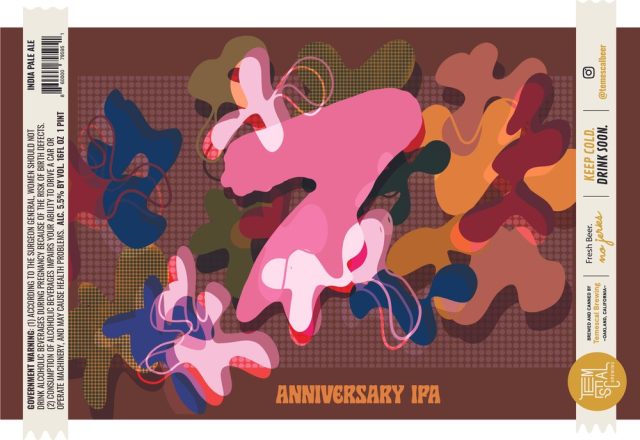
EG: The lively colors and organic shapes in your pieces seem to be a theme—what draws you towards these forms and colors?
JSR: I’m drawn to organic shapes because they feel alive and dynamic, like they’re always in motion. The vibrant colors stem from an effort to convey intense emotions like anxiety or excitement in a way that feels approachable and even joyful. It’s a way to reframe those feelings.
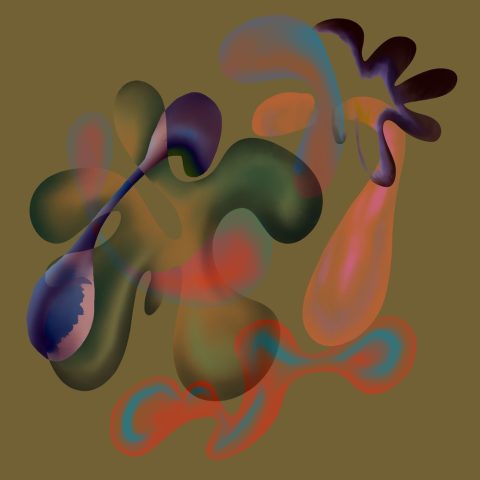
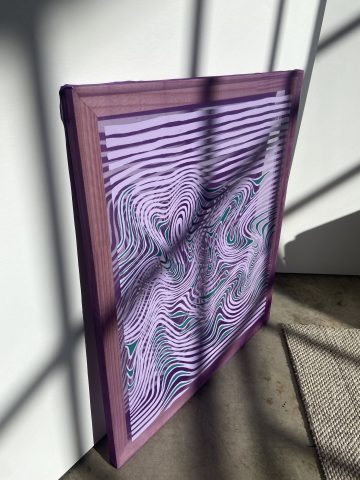
EG: Some of your work uses light and shadow to layer 2-D surfaces, in a way. What gave you this idea, if you don’t mind sharing?
JSR: Honestly, it came from my Punjabi roots and being at fabric stores in Punjab. I was inspired by the vibrant colors and textures of suits and sarees in various fabrics. I started painting on organza, a type of silk, to layer the base color of the fabric with my art. The shadows added this new layer of depth that I couldn’t get out of my head. It’s such an exciting process, and I’m working on a whole series where each painting is on silks.
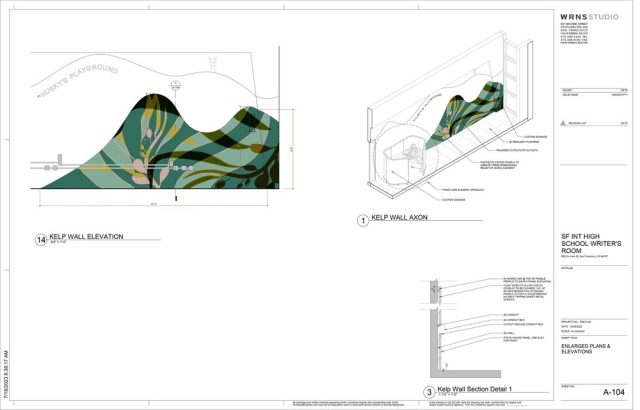
EG: Does architecture inform your art or the way you see the world? Tell us a little about your experience in architecture!
JSR: Absolutely. Architecture is inherently political, and my education at USF in the Bay Area emphasized the role architecture plays in communities—how it can displace people (gentrification) or help bring communities and families together. That education is also responsible for the sliding scale payment system I use for my prints online, making art accessible to a broader audience.
EG: Our world is always changing. What’s the state of transition/transformation of Oakland right now, in your eyes?
JSR: Oakland is a city of resilience and contrasts. While it’s facing challenges like gentrification and displacement, it’s also a place where the community takes care of each other, even when elected officials don’t. Programs like The People’s Program exemplify this spirit of mutual aid and grassroots action. Organizations like the East Oakland Collective also embody this ethos, supporting unhoused communities and advocating for equity. Local artists play a crucial role in amplifying community voices as well. For instance, my friend Taylor Smalls had an incredible art exhibition called “Throughline” honoring 13 Black women who uplift the community, and Lara Kaur created the Community Portrait Pop-Up to provide free portraits and document community stories. These efforts highlight Oakland’s enduring creative and communal spirit, showing how art and activism are deeply intertwined here.
EG: What’s your go-to coffee drink, and what do you think that says about your personality? No pressure!
JSR: My go-to is either a cortado or a ridiculously sugary latte, depending on my mood. What does that say about me? Probably that I’m a walking contradiction. The cortado screams, “I’m focused, sophisticated, and totally know what I’m doing,” while the sugary latte whispers, “I stayed up too late watching TikTok tutorials and need dessert disguised as caffeine to function.” It’s the perfect blend of “takes art seriously” and “accidentally drank paint water once.”

EG: Anything you’d like to add or promote? Do you have any current projects you’re working on that you’re particularly excited about?
JSR: I’m currently working on a new series that explores the emotional landscapes of liminal spaces. It’s exciting to push the boundaries of my style and see how people resonate with these ideas. I’d also love to invite folks to check out my print shop, which I just launched on my website. It features a sliding scale payment system to make art more accessible and inclusive, reflecting my belief in community building and creating connections through art. You can access it through my Instagram, and I’m thrilled to share this new way to connect with my work!

Latest Articles by Evan Gilman
Indonesian Coffee Cultivars and Varieties
By Evan Gilman With contributions from Surip Mawardi, Tovan Marhennatta, Chris Kornman Indonesian Coffee Cultivars and Varieties Coffee’s cultivated history on the world’s largest archipelagic state, and fourth-most-populous country, dates...
The Crown Gallery Artist Interviews: Alexis M. Brayton
The Crown seeks to give exposure to local and international artists through The Crown Gallery, and hosts new artists every four months. The Crown Gallery is currently accepting submissions for...
What to Do After the Q
The Crown is hosting the Q Arabica Combo. Becoming a Q Arabica Grader is one of the highest honors in the coffee industry. Serious study and practice are required to...