
By Evan Gilman
With contributions from Surip Mawardi, Tovan Marhennatta, Chris Kornman
Indonesian Coffee Cultivars and Varieties
Coffee’s cultivated history on the world’s largest archipelagic state, and fourth-most-populous country, dates as early as 1699, introduced by Dutch colonizer-merchants. The botanical origins of the Typica variety of Arabica were taken from the Indonesian island of Java to the botanical gardens in the Netherlands, and thereafter to the rest of the world. Coffee leaf rust decimated production in the late 19th century, and the islands soon became a proving ground for alternative species of coffee resistant to the fungus, Coffea canephora, colloquially known as Robusta. Liberica and Excelsa, too, were introduced to the islands in ongoing efforts to improve resilience and genetic diversity.
Today, Indonesia consistently ranks among the top five coffee producing countries (by volume), achieving close to 11 million 60kg bags in 2024. Over a third of the coffee grown on the islands is consumed locally rather than exported. That the islands of Indonesia remain relevant in modern coffee production is an uncommon feat. With a stock of hearty plants, an entrenched history of production, and proximity to an emergent boom in coffee consumer markets throughout Asia, places like Java, Sumatra, Sulawesi, Bali, and Flores—while still prone to warming and unpredictable weather, typhoons, and earthquakes—appear well positioned to sustain production into the foreseeable future.
It’s unsurprising, given this context, that the vast network of islands and their connection to coffee production and consumption have birthed an entirely unique subset of plant types and language. What follows is as comprehensive a summary of Indonesian coffee cultivars and varieties as we could compile.
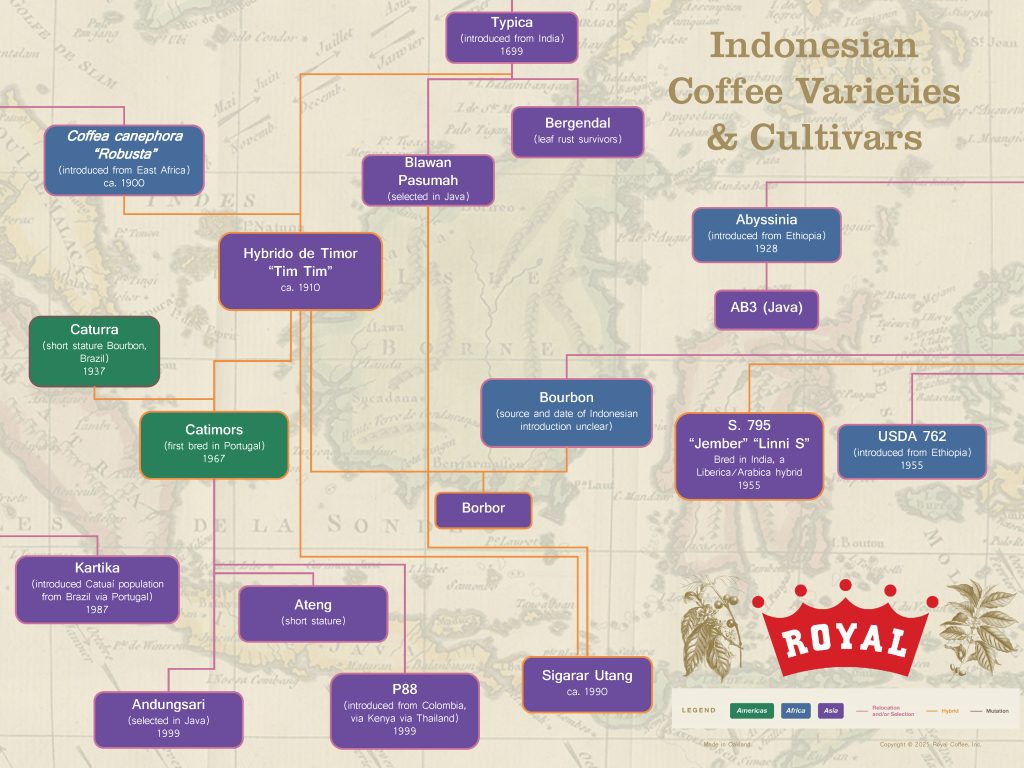 click to download a pdf of the Indonesian Cultivars infographic
Indonesian Coffee Cultivars and Varieties
Abyssinia: Simply called “Abyssinian Arabica” in P.J.S. Cramer’s posthumous A Review of Literature of Coffee Research of Indonesia, it would seem the author (and longtime director of coffee research in Java) introduced seeds from mother trees directly from “estates in Abyssinia” (what outsiders called Ethiopia, at the time) in 1928. 11 selections were brought to Indonesia, of which seven (AB1-AB7) were released. Still known locally in Indonesia as “Abyssinia,” (or as cognates “Adsenia” or “Abissinie”), AB3 would next travel from Java to Cameroon, where the tree’s genetics were preserved and eventually taken to Costa Rica, soon spreading throughout the Americas. Morphologically similar to Typica, it’s often been mistaken for a relative, but World Coffee Research’s genetic fingerprinting validates its provenance as directly Ethiopian. AB3 is known worldwide as “Java.”
Andungsari: A selected dwarf Catimor that prefers full sun and requires high inputs. Susceptible to leaf rust. Andungsari 1 was selected in 1982 by the Indonesian Coffee and Cocoa Research Institute (ICCRI) in East Java through agronomic trials including yield, quality, and other factors. These trials were conducted over the course of about 17 years, and it was officially released as a commercial variety by the Ministry of Agriculture in 1999.
Ateng: Short for “Aceh Tengah”, also the name of a remarkably short comedian, Andreas Leo Ateng Suripto. This is a Catimor selected for low height, easy to pick shrubs. Generally grown at lower altitudes due to its disease resistance, it’s not considered to be a high quality cultivar, but is planted widely. Sometimes called “Ateng Jeluk” or “Ateng Super.”
Bergendal: Apocryphally, old Typica-type trees that survived the first Coffee Leaf Rust outbreak in the late 19th century.
Blawan Pasumah: A Typica selection from East Java, likely the namesake of the Blawan Estate.
Borbor: Hybrido de Timor crossed with Bourbon.
Gayo Dua: A cross of Tim Tim (Hybrido de Timor) with Bourbon. Also subject to variance due to interbreeding and growing from seed. Rumors of being crossed with S. 795 rather than Bourbon. See also: Borbor.
Gayo Satu: Originally a selection of Hybrido de Timor, but now effectively a cross of Tim Tim and other locally grown varieties, generally only found in Gayo.
Hybrido de Timor: The original Canephora-Arabica hybrid, a spontaneous occurrance subsequently reproduced commercially—and is no longer commonly found other than in the genetics of more popular cultivars. Sometimes abbreviated as HdT. Known locally as Tim Tim.
Java: See Abyssinia
Jember: See S. 795
Kartika: Literally “Kopi Arabica Tipe Katuai” or Catuai variety coffee. Brought to Indonesia in 1987 as part of a Portuguese multi location variety trial. Can achieve high quality but is very susceptible to leaf rust, and requires high inputs.
Komasti: A portmanteau of Komponen Andungsari Tiga (literally: Andungsari Component Three), and a product of the ICCRI (Indonesia Coffee and Cocoa Research Institute) aka Puslitkoka. This variety is actually comprised of six genotypes, so there is concern about stability of genetics when grown from seeds. Growers appreciate this cultivar for fast fruiting and large cherry size, as well as coffee leaf rust resistance not found in the original Andungsari variety.
Kopyol: A cross of Tim Tim (Hybrido de Timor) with other local species, generally found only in Bali.
Lini S: See S. 795
Onan Ganjang: A selected variety from Humbang Hasundatan Regency, southwest of Dolok Sanggul in North Sumatra. According to some it’s a full Arabica, but purported by others to be a cross of Bourbon and S. 795 genetics. This variety was selected for its large bean size.
P88: A Colombian (presumably Catimor) selection first introduced in Kenya, then in Thailand. P88 was then taken to Gayo by way of Thailand in 1989.
Rambung: Sometimes used as a synonym for Abyssinia AB7. Alternatively used to indicate a cross of AB7 and Hybrido de Timor.
Rasuna/Lasuna: Reportedly a cross of Typica and Catimor.
S. 795:Released in 1946 by India’s Central Coffee Research Institute (CCRI) as “Selection 3,” it is still grown widely in both India and Indonesia (where it’s locally known as Lini S or frequently Jember, after its namesake research station in East Java, through which it was introduced to the region beginning in 1955). It is bred from Kent and an interspecific hybrid of Liberica and Arabica known as S. 228 (CCRI’s “Selection 1”), whose development dates to the mid-1930s and supposedly was initiated by a spontaneous hybridization.
Sigarar Utang: Sometimes written Sigararutang, this is a hybrid cross of Arabica and Hybrido de Timor selection 831, and it is shrouded in a veil of lore and misinformation. The name can be literally translated as “the payer of debts,” a nod to the tree’s quick maturation and high productivity. It is sometimes confused with Ateng (a Catimor) but is generally regarded as distinct (although some sources indicate that Sigarar Utang is a selection of Ateng). Rumors surrounding its selection date to the late eighties by Opung Sopan Boru Siregar in Desa Batu Gajah, Paranginan, Lintong, Humbang Hasundutan on Sumatra. It was purportedly introduced by ICCRI in the 1990s and definitively endorsed by the Ministry of Agriculture in 2005. Genetic testing indicates that it clusters closely with Ateng but is likely a Typica (Blawan Pasumah) crossed with Hybrido de Timor.
Tim Tim: Short for “Timor Timur” or East Timor. This is the original Hybrido de Timor—a Canephora-Arabica hybrid—and is no longer commonly found other than in the genetics of more popular cultivars.
USDA: Officially USDA 762 selection, taken from Ethiopian stock originating in Mizan Tafari in the western Kaffa region, collected by Jean B. H. Lejeune. Brought to Indonesian by FAO in 1955. Pronounced “oos-dah.”
Other known cultivars with unclear taxonomy/provenance: Gayu Tigre, and Kobra. (We’ll update this page with more information as it becomes available.)
A botanical illustration of Coffea Arabica

Latest Articles by Evan Gilman
The Crown Gallery Artist Interviews: Jasmine Singh Rosado
The Crown seeks to give exposure to local and international artists through The Crown Gallery, and hosts new artists every four months. The Crown Gallery is currently accepting submissions for...

The Crown Gallery Artist Interviews: Alexis M. Brayton
The Crown seeks to give exposure to local and international artists through The Crown Gallery, and hosts new artists every four months. The Crown Gallery is currently accepting submissions for...
What to Do After the Q
The Crown is hosting the Q Arabica Combo. Becoming a Q Arabica Grader is one of the highest honors in the coffee industry. Serious study and practice are required to...