
Article Summary:
Green coffee has traveled a long and complex global path from its origins in Africa to modern supply chains linking farmers to roasters worldwide. History: Arabica originated in Ethiopia and South Sudan before spreading to Yemen, where commercial cultivation began in the 15th century. From there, Dutch and French colonizers carried coffee across Asia, the Americas, and the Caribbean, establishing the crop globally by the 19th century. Robusta emerged later, first cultivated in the Congo basin and eventually expanding across Africa and Southeast Asia. By 2023, 79 countries produced coffee. Modern Supply Chain: Today’s green coffee trade connects smallholder farmers, cooperatives, wet and dry mills, exporters, importers, and roasters. Each stage, harvesting, processing, milling, shipping, and warehousing, adds value and complexity. Green coffee beans may pass through thousands of hands and multiple ports (like Santos, Dar es Salaam, or Oakland) before reaching the cup.
Exploring the Global Journey of Green Coffee Beans
Green coffee, the unroasted seeds of the coffee fruit, is cultivated in dozens of countries worldwide and the journey – both historically from its origins in Africa to its modern status, and logistically from the farm to your cup – is complex and fascinating. As with so many of the best things in life, the journey is so much more than just reaching the destination.
A Brief History of Green Coffee Origins
Arabica, the world’s most popular globally cultivated species of coffee, traces its origins to what is now western Ethiopia and South Sudan somewhere between 10,000 and 1 million years ago. Canephora (Robusta) and Liberica (including Liberica’s “Excelsa” cultivar) evolved before Arabica (despite being globally cultivated much later), and have genetic origins in various regions across central and western sub-Saharan Africa; the Congo basin is often given as the consensus origin of Robusta.
From Ethiopia, Arabica first escaped to modern-day Yemen (likely around the year 1450) where it was cultivated commercially for the first time in history. Yemen popularized coffee to the world, and under the umbrella of the Turkish Ottoman Empire (wherein advancements such as roasting the beans, and preparing them by grinding and brewing were invented), it quickly became a globally enjoyed beverage.
From Yemen, a Dutch merchant stole a tree and planted it in Amsterdam’s botanical gardens, which was used to propagate crops in Western India, alongside seeds smuggled from Yemen by a Indian monk named Baba Budan, sometime around 1660-1670. The Dutch then brought the crop to Sri Lanka and Indonesia’s island of Java before the end of the 17th century.
Within the first two decades of the 18th century, the French brought coffee from Yemen to Reunion Island and began propagating trees in the Caribbean not far from the Dutch colony of Surinam, where coffee was also planted. Guatemala, Costa Rica, and Mexico would follow shortly after in Central America. Colombia, Venezuela, and Brazil, too, were early adopters of the colonially introduced crop.
By the end of the 18th century, most Caribbean islands including Jamaica, Cuba, Haiti, and Puerto Rico, Caribbean costal South America (including Colombia and Venezuela), parts of Central America, Mexico, and Brazil had all been planted with commercially viable coffee fields. El Salvador, Nicaragua, Honduras and Hawaii were planted by the middle of the 19th century, while Panama, Peru, Ecuador, and Bolivia wouldn’t add commercial volumes of coffee to their mountainsides until the early 20th century.
Robusta was first reported as commercially cultivated in what is now the Democratic Republic of Congo in 1870, and its scientific recognition as a distinct species was published in 1897. French colonizers introduced it to Vietnam possibly as early as the mid-1800s and definitively by the first decade of the 20th century. It reached Java in Indonesia around the same time and quickly replaced the rust-decimated Arabica trees throughout the South Pacific. Robusta also found commercial home in central and western Africa, including the Central African Republic and Guinea, Africa’s top-producing nations after Ethiopia and Uganda. It can be found today in Côte d’Ivoire, Cameroon, Togo, Angola, and in small quantities throughout sub-Saharan west and central Africa.
The French brought Arabica (var. Bourbon) from Reunion back to Africa’s mainland, first to Tanzania in 1877. Kenya, Uganda, Malawi, Rwanda, Burundi, Zambia, Zimbabwe, and Madagascar were all colonized with coffee in the late 1800s and early 1900s.
While mainland Asia’s primary coffee producing countries have long been India and Vietnam, coffee now grows in countries like Nepal, China, and the entire southeast Asian peninsula including Thailand, Myanmar (Burma), Laos, and Cambodia. The Pacific islands growing coffee include Indonesia’s Sumatra, Java, Sulawesi, Bali, and Flores, the Philippines, Timor-Leste, Papua New Guinea, Taiwan, and many others.
Worldwide, the Food and Agriculture Organization (FAO) reported 79 countries and territories producing coffee in 2023.
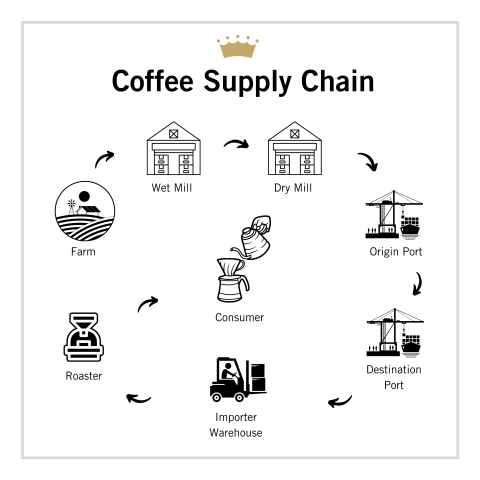
Understanding the Modern Green Coffee Supply Chains
Connecting producing regions to coffee-drinking customers is a path with many forks, all of which begin to look more similar than disparate when taking a global perspective.
Behind the green coffee supply chain’s usual starting point – the farmer – exists an esoteric network that supplies and supports essential farming operations, including agronomists, plant breeders, research scientists, fertilizer producers, day laborers, and more. Smallholder farmers frequently part with coffee cherries after harvesting, exchanging them for local currency at a cooperative or privately run mill, where the fruits will be processed. Estate farmers frequently have this infrastructure on site and can add value to their crop through this service.
The wet mill (or beneficio, washing station, pulpery, central pulping unit, factory, etc.) provides a number of services to raw coffee. All coffee must pass through some form of machinery to remove its skin and part/all of its fruit. For fully washed, and hybrid process coffees (like pulped naturals or honeys, e.g.) this happens at a wet mill. Wet mills are located in the field, close to where coffee grows, as it must be processed and drying begun shortly after harvesting.
Dry mills, however, are often centrally located in more industrial areas with good access to electricity. This could mean the coffee, once dried at the wet mill, might travel many miles and hours to its next destination. The dry mill hulls coffee, sorts it by size, density, and defects, and bags the coffee for export.
Once the green coffee is ready to ship internationally, it must be contracted by a buyer, usually a roaster or importer, and brought to port by an exporter. If the producing country is landlocked (like Bolivia, Ethiopia, or Rwanda, for example) additional logistics must be accounted for. However, many countries that produce coffee have access to international ports, prominent examples include Brazil’s port of Santos in São Paulo, Dar Es Salaam in Tanzania, or Port Belawan in Medan on Indonesia’s island of Sumatra.
Green Coffee is loaded onto containers, which are then loaded onto boats, which pass through international waters, often making additional port calls before reaching the destination. In the United States, some of the busiest ports for coffee importation include Newark, Charleston, Baltimore, New Orleans, and Oakland.
From the port, coffee typically will be warehoused close-by, until it is sold and delivered to a roaster, who will then process and package it, and send it off to the final customer either in a café or directly to their doorstep.
These supply chains, linked by qc professionals, logistics specialists, physical labor, and long miles of winding pathways, remain an important part of the story of coffee’s journey, passing through innumerable hands (estimates put the number of people involved in a single container, from tree to cup, in the thousands), each of whose livelihoods depend upon the careful cultivation, transportation, and trade of coffee.

Latest Articles by Chris Kornman

Notes Between Cuppings Entry 1
Co-fermented coffee is a new processing approach where producers add natural ingredients like fruit, hops, or spices during fermentation to enhance flavor complexity. Unlike flavored coffee, these additives interact with...
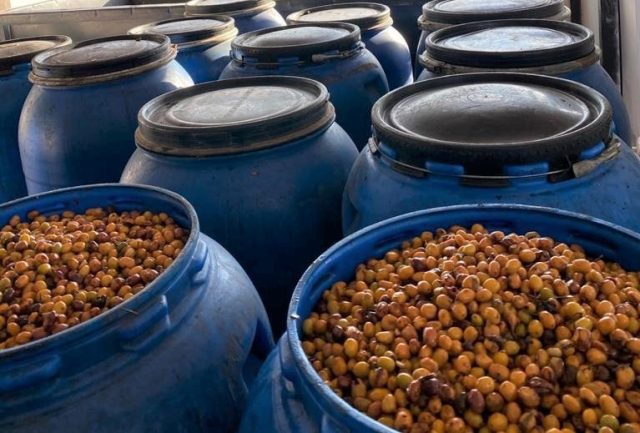
Excerpt: Additive Fermentation: “Infused” Coffee is Gaining Popularity and Sparking Industry Debate”
Co-fermented coffee is a new processing approach where producers add natural ingredients like fruit, hops, or spices during fermentation to enhance flavor complexity. Unlike flavored coffee, these additives interact with...

Are All Green Coffees the Same? Factors That Affect Their Flavor
Explore July 2025 Crown Jewel coffee arrivals from Sumatra, Ethiopia, Tanzania, and more. Bold flavors, innovative processing, and standout producers.