
A Roaster’s Guide to Coffee Seasons
The idea that a particular crop, in our case coffee, is available and fresh for a portion of the year – is now long-ingrained in specialty coffee conversations.
Like all other fruit, coffee berries have a finite shelf life. Unlike many other drupes, we covet the seeds rather than the pulp, and so a green coffee’s freshness is related not just to its immediate harvest timeline, but also to the length of time it takes to process (i.e., remove the seeds from the fruits and prepare them for storage and transit), the duration of international shipping, and the somewhat extended (but far from infinite) flavor of freshness during green coffee’s time on a shelf, waiting to roast.
(How long do green coffee beans last? Check out our storage summary blog!)
The Harvest and Shipping Timeline
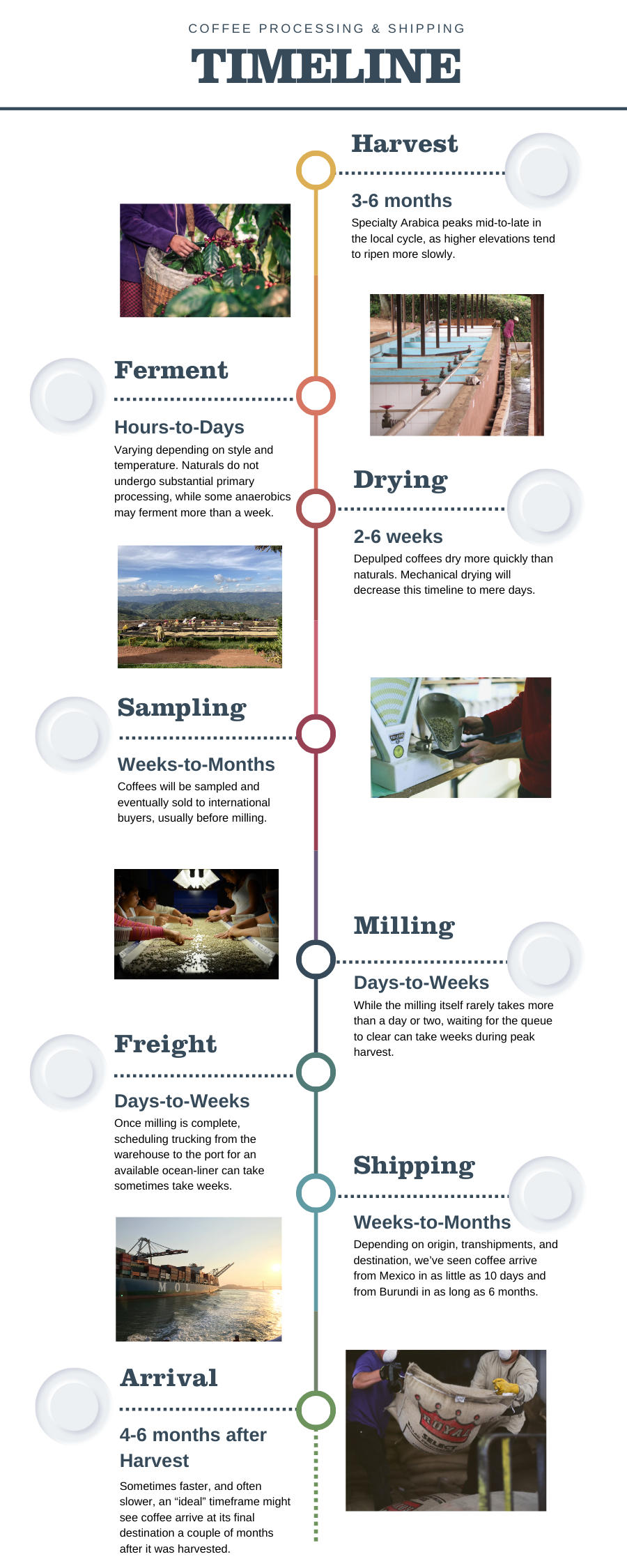
Coffee’s flowers must bloom, albeit briefly, before the fruits set and begin to mature. Blossoming is triggered by rain after a hot and dry spell, and cherry growth often takes six months or more. Tropical weather tendencies — with plenty of irregularities — still differ predictably by hemisphere, so the rains in Brazil in September and October result in harvests starting in May and June, whereas late spring and summer rains in Mexico will produce mature fruit before the end of the calendar year.
For the most part, this holds true worldwide: harvests of specialty-quality Arabica occur during the hemispheric winter. Thus, based on nothing other than geography, a roaster can know — within a margin of error — when cherries are being picked.
When I used to travel more, I’d usually try to time my visits to coincide with the peak of harvest — a fairly common convention for buyers visiting their producers. It affords the opportunity to cup early harvest, take photos at nearly every step of the process, and still have a say in how the later-picking lots may turn out. Even the smallest micro-region may harvest for extended time periods depending on factors like weather, plant variety, and available labor. Thus, if the yield is large enough, early harvests may be ready to ship as much as four or five months before the final pass for the season.
And yet, even coffees harvested simultaneously in different parts of the globe may arrive in our warehouse at different times. This can be due to processing methods, logistics, seasonal variations, trade route configurations, customs holds, political interferences, or other factors. Given this reality, even the best laid plans can’t guarantee a coffee’s arrival time.
Common Harvest and Arrival Timeframes
Consider the map below in broad strokes, as it displays the customary season corresponding to a coffee’s peak arrival time in the United States — specifically, at our warehouse here in Oakland. (The map is interactive, tap or click on the tabs near the top to switch back & forth.)
Arrival times, beyond being contingent on harvests, are also typically subject to approval of samples. Coffees in most places in the world will not move to a new destination without a confirmed purchase. Thus, even though a coffee from Costa Rica might be finished and ready to ship in April, a sample approval, contract agreement, and shipping schedule might not be arranged until June for an August arrival.
All this to say, for most given purchases at Royal Coffee, the date of debarkation at the Port of Oakland is likely more related to when we approve a sample than when it was actually harvested. A relationship between harvest period and sampling may be implied, but nothing should be assumed as a given.
Additionally, we should talk about just a few of the innumerable exceptions. Secondary harvest cycles, known as “fly crop” or mitaca, are irregular summer harvest periods usually marked by lower volumes and quality. For whatever reason, Kenya has become a known quantity for fly crop, perhaps because a budget-conscious roaster can get a cheap lot during an off cycle.
Many representatives of Colombia’s grower federation, the FNC, will repeat the claim that in Colombia, the harvest is year-round. The unique positioning of the country on the Earth’s equator in combination with the Andean Mountain range, as it splits into three major spines, produces highly variable rainfall throughout the country. Multiple regions experience mitaca, and indeed bulked Colombian coffee without regional traceability is generally available year-round — though the same can often be said about other origins, as well.
In general, Colombia’s most coveted traceable specialty coffees from Cauca, Huila, and Nariño tend to harvest between April and July, arriving stateside between October and January — comparable to neighboring Ecuador and Peru, for example. However, older traditional growing regions in the north like Santander, Antioquia, and Magdalena, tend to act a little more like early Northern Hemisphere harvests, picking during our fall and winter and arriving stateside during the spring and summer. But even within individual departments, regions may vary wildly enough to have completely different harvests. Examine the map below (intellectual property of FNC) where you can observe stark variation in relatively small distances due to topography, trade winds, rain cycles, and various other environmental factors.
Below you can see a summary of annual arrival timeframes to our Oakland warehouse. In some cases, I’ve elected to call out differences in timeframes from the two data collection periods, and in others it made more sense to bundle them together1.
Royal purchases substantial volumes of Colombian coffee, but not from every producing region. We’re also selective about grade, supply partners, and other factors that affect supply. As a result, we have some inconsistencies in arrival timelines but find our largest volumes arriving in the fall and winter, with some year-to-year inconsistencies.
Other regions of the world are more predictable. Our imports from Costa Rica generally remained steady over the last decade or so, with arrivals peaking between April and June, and generally falling to near-zero levels during the fall.
When comparing our original numbers from 2016-2018 to more recent figures from 2022-2024, a few regions began to stand out to us as having shifted uniquely in timeframes. One worth noting is Ethiopia, a country whose exports had already significantly shifted later between 2016 and 2018 and moved further into the year as climate and political issues harried exports from Arabica’s homeland.

Latest Articles by Chris Kornman
Notes Between Cuppings Entry 1
Co-fermented coffee is a new processing approach where producers add natural ingredients like fruit, hops, or spices during fermentation to enhance flavor complexity. Unlike flavored coffee, these additives interact with...
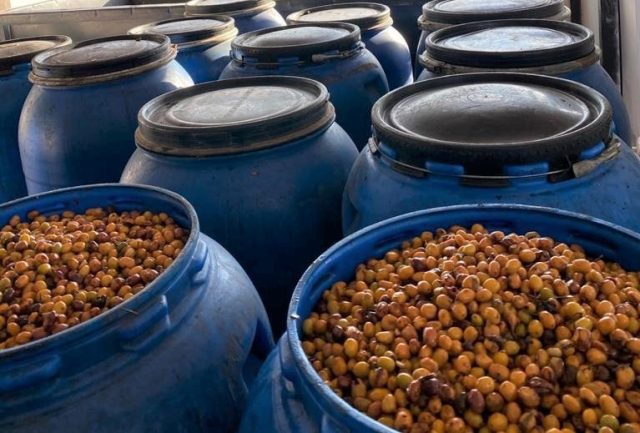
Excerpt: Additive Fermentation: “Infused” Coffee is Gaining Popularity and Sparking Industry Debate”
Co-fermented coffee is a new processing approach where producers add natural ingredients like fruit, hops, or spices during fermentation to enhance flavor complexity. Unlike flavored coffee, these additives interact with...
Are All Green Coffees the Same? Factors That Affect Their Flavor
Explore July 2025 Crown Jewel coffee arrivals from Sumatra, Ethiopia, Tanzania, and more. Bold flavors, innovative processing, and standout producers.