
Article Summary:
Royal Coffee’s study examines how green coffee storage conditions and moisture levels affect green coffee’s quality and flavor over time. Two coffees, a high-moisture Sumatra (15%) and a low-moisture Bolivia (8.7%), were stored in jute and Ziploc packaging under stable conditions. Results showed that coffees respond rapidly to environmental humidity: Sumatran coffee dried quickly in jute, while Bolivian coffee absorbed moisture. Airtight storage preserved stability and cup quality more effectively than jute. Best practices: Maintain stable temperature and humidity, use protective or near-hermetic packaging, follow “first in, first out,” and roast close to arrival for optimal flavor.
The Theory of Relative Humidity – Part 1 (Excerpts)
Observing Physical and Sensory Changes in High- and Low-Moisture Green Coffees Under Different Storage Conditions
By Chris Kornman and Isabella Vitaliano
(excerpts taken from Roast Magazine’s May/June 2025 issue, reprinted with permission)
You can view the full issue here: https://www.roastmagazine.com/issues/129 and explore the data visualizations for our research here: https://www.roastmagazine.com/relativehumidity
What is the right moisture content for green coffee?
There’s little debate that coffee must be dried prior to milling, shipping and storage. However, individual coffee professionals and organizations may have varying standards, and even industry regulators and trade groups have had a difficult time agreeing on the answer to this question.
Since 2004, the International Coffee Organization has defined allowable export ranges from 8 to 12.5 percent. In 2021, in its fourth edition of The Coffee Guide, the International Trade Centre established recommended limits between 11 and 12 percent and cautioned that quality loss occurs with anything under 10 percent. Current Specialty Coffee Association (SCA) language avoids discussion of moisture in favor of an upper limit (0.7) for water activity, but prior to 2017’s merger between the Specialty Coffee Association of America (SCAA) and the Specialty Coffee Association of Europe (SCAE) legacy language did specify ideal moisture ranges. In 2004, the organization defined the ideal range as “between 9 and 13 percent.” A revision was published in 2013 dictating “washed processed coffees should be between 10 [to] 12 [percent] upon import.” Moisture content is tested on arrival at an importer’s quality control facility.
Moisture content and water activity may indicate how well drying was performed during the later stages of processing. These metrics are important for the safety and health of consumers of roasted coffee. If either is too high, it can predict potential mold and bacterial growth on the green coffee. For that reason, we record moisture content for preshipment samples of green coffee before it ships to the U.S. from overseas in order to make sure green coffee doesn’t go bad during this shipping period.
Water activity is an indicator of microbial, chemical and physical properties. It is used to measure safety and anticipates the potential for a chemical and physical reaction. Both moisture content and water activity can signify how a coffee will perform in the roaster as well as its shelf-life stability. There are certain flavors that are associated with aged or past-crop coffees, which may be expedited by moisture loss, high water activities, and other water- and storage-related factors.
Past-crop flavors can reduce cup quality ratings and may taste like paper or cardboard in the cup. International coffee shipping, depending on origin and destination, typically takes a month or two, and in some cases (such as we saw during the height of the pandemic) over six months, for a coffee to arrive from an origin port to the purchasing country. If processing and drying is not done correctly, this can lead to reduced cup quality. Drying in particular is an important step in preventing these flavors.

Our Experiment
We knew from common sense and prior experience that coffee left exposed to the elements of any environment (as is the case in unlined jute packaging) will change more radically and rapidly than protected coffee (such as in GrainPro, Ecotact or similar packaging). What we weren’t prepared for was for how quickly and dramatically the green coffee responded to its environment. We were also surprised at the medium- to long-term sensory impact of storage, regardless of packaging type.
We chose extraordinary coffees, well outside of “normal” ranges, to help us understand coffee’s physical makeup and sensory quality over time.
Moisture Changes
A Sumatran coffee, arriving on March 15, 2024, at 15 percent moisture, dried about 1 percentage point per day for three consecutive days. By the time its dehydration had stabilized, the coffee settled at around 9 percent and remained there from March 29 until the termination of our testing on June 20. The storage room metrics (for both coffees) were stable with relative humidity at roughly 49% and average temperatures around 70 degrees Fahrenheit. The same coffee, stored in Ziploc packaging, held steady above 14 percent moisture until May, when it too began to dry out. By June the moisture content of this coffee was down to 12.6 percent.
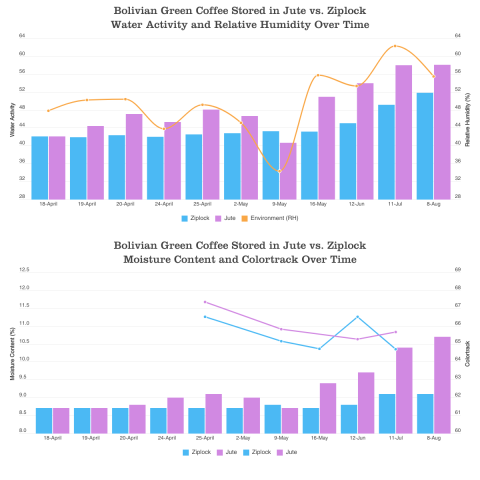
A Bolivian coffee, arriving on April 18, 2024, at 8.7 percent moisture, changed more gradually. While the coffee held in Ziploc never surpassed 9.1 percent moisture, the jute-stored beans began to show moisture absorption within a week and peaked at nearly 11 percent by the end of the study in early August.
Flavor Changes
For both the Sumatran and Bolivian coffees, we compared a total sum of words used for Ziploc versus jute, then compared each packaging type’s early tastings to later ones. In all cases, there’s data of interest to explore.
Sumatra
When comparing the Ziploc-stored coffee to that stored in jute, several differences emerged. Overall, the Ziploc- stored coffee was smoother, sweeter and sourer. Further, cuppers checked boxes for “dry acidity,” “musty/earthy,” “rough” and “spicy” nearly twice as often for the coffee stored in jute. These descriptors, frequently associated with a negative connotation, may indicate a likely overall preference for the coffee packed in the airtight environment.
Bolivia
The Bolivian coffee showed relatively little “papery” flavors throughout the course of our cupping, reflecting fewer flavors commonly associated with “past-crop” coffees than the Sumatra. However, it did provide us with some valuable insights as to the way that absorbed moisture can impact a coffee’s flavor.
Comparing the Ziploc-stored coffee with that held in jute, the Ziploc coffee had higher frequencies of “cocoa,” vanilla,” and “sweet acidity” descriptors, and more “roasted” (despite its lighter ColorTrack scores).” Cuppers used the “sweet” descriptor 22% more frequently for the jute-stored coffee.
Practical Takeaways for Coffee Professionals
Ultimately, our study validated a few best practices for roasters and challenged a few other preconceptions. We recommend that when milling is completed and coffee is prepared for shipping, high-quality coffees be stored in relatively stable temperatures and humidities and protected with near-hermetic storage when possible. We also recommend roasters and importers maintain similar storage conditions and preserve the integrity of the green coffee’s packaging (e.g., not using hooks to lift jute bags with interior protective liners). Our cuppers, unsurprisingly, had more favorable flavor notes for coffees roasted as close to their arrival date as possible. No storage type will perfectly preserve cup quality over time.
Usual best practices for perishable goods include a “first in, first out” policy, with which we generally concur for shipping or roasting green coffee. Exceptions might include coffees with risky moisture contents or compromised storage conditions, which we’d recommend prioritizing for roasting to ensure the coffee is consumed at its peak quality.
For additional practical takeaways, data insights, and more, check out the original publication and the companion data visualizations.

Latest Articles by The Crown
Hey Mambo! Assume Nothing Drink Recipe
By Asha Wells “Assume Nothing!” A mantra for The Crown as we worked towards opening our doors in March of 2019, the phrase became a Menu section, encouraging our visitors...
Understanding Coffee Acidity: What It Is and Why It Matters
Article Summary: Coffee acidity describes flavor brightness. Most brews sit near 5.5 pH. Acidity comes from organic acids in green coffee and changes through roasting: lighter roasts retain fruity malic...
Why Coffee Origins Matter: Flavor, History & Global Impact
written by Isabella Vitaliano, Lab and QC Specialist Article Summary: Coffee origin shapes cup profile, availability, pricing, and storytelling. Knowing country context helps buyers match flavor goals and manage risk....
Very interesting piece!
I wonder how you measure humidity levels of the coffee. Illy I know is quite obsessive on this point; a batch measurement may read, say, 11% but doesn’t tell you much about the spread of individual beans. I have a PPT they showed in Colombia, insisting that they prefer a narrow range of individual bean RH% but that poor drying will lead to a broad range. They prefer the Guardiola method of mechanical drying for instance.
I wonder too if storage in ziplocks might help even out the range, as drier beans absorb humidity from moister ones.